
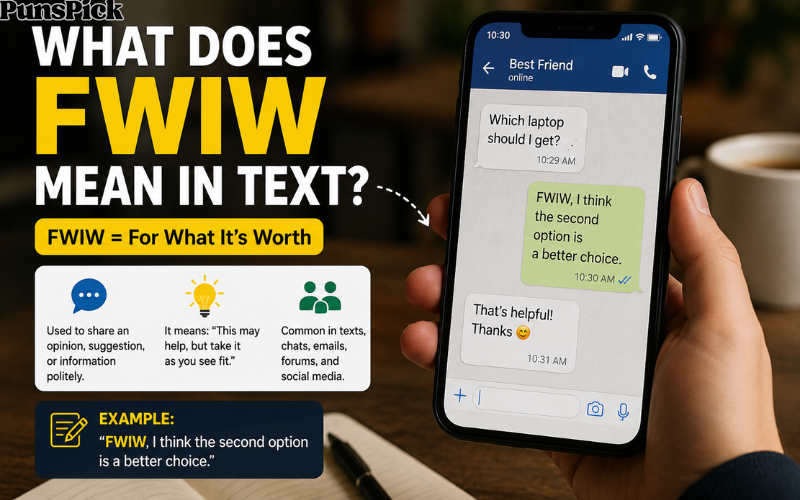
If you have seen “FWIW” in a text message, social media post, comment, or online conversation, you may have wondered what those four letters mean. FWIW is a common internet and texting abbreviation that stands for “For What It’s Worth.”
People usually use FWIW when they want to share an opinion, suggestion, fact, or personal experience without making it sound like an absolute answer. It can be a polite way to introduce an additional thought, especially when the speaker knows that their opinion may not change the situation.
For example, someone might text:
“FWIW, I liked the first movie better.”
This means:
“For what it’s worth, I liked the first movie better.”
The person is sharing their opinion while recognizing that the other person may feel differently.
I often find FWIW useful to understand because it can carry a slightly different tone depending on the conversation. It can sound helpful, neutral, polite, casual, or even mildly sarcastic when used in the right context.
In this guide, I’ll explain FWIW meaning in text, what it stands for, how people use it, what it means in different situations, how to respond, and how it compares with similar texting abbreviations.
Related Post: What Does WYGG Mean in Text? Meaning, Uses, Examples, and More
What Does FWIW Mean in Text?
FWIW means “For What It’s Worth.”
It is an informal abbreviation commonly used in text messages, social media, forums, emails, and online conversations.
The phrase is usually placed before an opinion, suggestion, piece of information, or personal experience.
For example:
“FWIW, I think you made the right choice.”
This means:
“For what it’s worth, I think you made the right choice.”
The sender is not necessarily saying that their opinion is the final answer. Instead, they are offering their perspective for the other person to consider.
Here are a few simple examples:
- “FWIW, I agree with you.”
- “FWIW, that restaurant is really good.”
- “FWIW, I had the same problem.”
- “FWIW, I would wait until tomorrow.”
- “FWIW, I think the blue one looks better.”
In each case, FWIW introduces information or an opinion that the sender believes may be useful.
What Does FWIW Stand For?
FWIW stands for:
For What It’s Worth
The abbreviation is formed from the first letters of the words:
| Letter | Word |
| F | For |
| W | What |
| I | It’s |
| W | Worth |
So:
FWIW = For What It’s Worth
The full phrase has been used in English for a long time, while the abbreviated version became popular through online communication, forums, email, instant messaging, and texting.
When someone writes FWIW, they are essentially saying, “This may or may not be useful to you, but here is my opinion or information.”
What Is the Simple Meaning of FWIW?
The easiest way to understand FWIW is:
“For what it’s worth, here is my opinion or information.”
It can also be understood as:
- “If it helps…”
- “In my opinion…”
- “Just so you know…”
- “You may find this useful…”
- “This is only my perspective, but…”
- “Take this for what you will…”
The exact wording changes with the situation, but the basic purpose remains similar.
For example:
“FWIW, I would choose the second option.”
The sender is not necessarily telling you that you must choose the second option. They are simply sharing their preference.
How Is FWIW Used in Text Messages?
FWIW is generally used to introduce an additional thought.
It can be useful when someone wants to give an opinion without sounding too forceful.
For example:
Friend: “I’m thinking about changing jobs.”
You: “FWIW, I think you’d do well there.”
You are expressing support without presenting your opinion as a fact.
Another example:
“FWIW, I had a really good experience with that company.”
This tells the other person that you have personal experience that may help them make a decision.
FWIW can also be used when someone has already made a decision.
“I know you’ve already ordered it, but FWIW, I really like that model.”
Here, the sender knows their opinion may not change anything, but they still want to share it.
Why Do People Use FWIW?
People use FWIW because it softens the way an opinion is presented.
Compare these two messages:
“You should buy the black one.”
and:
“FWIW, I think the black one looks better.”
The first message sounds more direct and authoritative.
The second sounds more like a personal opinion.
FWIW can therefore make a message feel less demanding.
It is particularly useful when:
- You are giving advice.
- You are sharing a personal experience.
- You want to offer another perspective.
- You are disagreeing politely.
- You want to add information.
- You are not sure whether your opinion will be useful.
- You want to make a suggestion without pressuring someone.
FWIW Meaning in a Conversation
The meaning of FWIW stays basically the same across most conversations, but its tone can change.
For example:
“FWIW, I agree.”
This sounds supportive.
“FWIW, I disagree.”
This introduces a different opinion in a relatively soft way.
“FWIW, I tried that restaurant last week.”
This provides personal experience.
“FWIW, the deadline was moved to Friday.”
This provides information.
The abbreviation itself does not tell you whether the message is positive or negative. The words that follow it usually provide that information.
FWIW Meaning When Giving Advice
FWIW is commonly used when someone wants to offer advice.
For example:
“FWIW, I would talk to your manager before making a decision.”
The sender is suggesting an action but is not necessarily demanding that the person follow it.
Another example:
“FWIW, I would save the file before updating the software.”
This sounds like a personal recommendation.
The phrase can be helpful because advice can sometimes sound too forceful. Adding FWIW makes it clear that the sender is offering their perspective rather than claiming to know exactly what the other person should do.
FWIW Meaning When Sharing an Opinion
FWIW is also common when expressing an opinion.
For example:
“FWIW, I think the new version is better.”
The speaker is making it clear that this is their personal view.
Another example:
“FWIW, I liked the original design more.”
The sender is sharing a preference without suggesting that everyone should agree.
This makes FWIW especially useful during discussions where people have different opinions.
FWIW Meaning When Disagreeing
One interesting use of FWIW is when someone wants to disagree without sounding overly aggressive.
For example:
“I understand why you chose that option. FWIW, I would have gone with the other one.”
This is much softer than simply saying:
“You chose the wrong option.”
FWIW does not automatically make disagreement polite, but it can frame the statement as a personal perspective.
Another example is:
“FWIW, I don’t think that’s the best approach.”
The sender is disagreeing, but they are presenting it as their assessment rather than an unquestionable fact.
FWIW Meaning in a Friendly Conversation
FWIW is not limited to serious conversations.
Friends can use it casually.
For example:
“FWIW, that new pizza place is amazing.”
Or:
“FWIW, your presentation was really good.”
Or:
“FWIW, I think you made the right decision.”
In these situations, FWIW simply introduces something the sender thinks is worth mentioning.
It does not have to indicate a disagreement or serious discussion.
FWIW Meaning in Social Media
FWIW is also common on social media.
People may use it when adding their perspective to a discussion.
For example:
“FWIW, I’ve been using this phone for two years and haven’t had any problems.”
Here, the person is sharing personal experience.
Another example:
“FWIW, I prefer the original version.”
This is simply an opinion.
Because social media conversations often include many different viewpoints, FWIW can be useful for indicating that a statement represents one person’s perspective.
FWIW Meaning in Comments
You may see FWIW in online comments when someone wants to contribute additional information.
For example:
“FWIW, I had the exact same issue after the update.”
The commenter is sharing a relevant experience.
Or:
“FWIW, the store usually has better prices on weekends.”
The commenter is providing information that may help someone else.
This use is especially common in discussions where people are asking for recommendations or personal experiences.
FWIW Meaning in Online Forums
FWIW has been widely used in online discussions and forums.
A person might write:
“FWIW, I’ve owned both models and prefer the older one.”
This indicates that the person has personal experience and is offering it as one perspective.
Another person might reply:
“Thanks. That’s actually helpful.”
FWIW can therefore be a useful way of contributing information without pretending that personal experience is universal.
FWIW Meaning in an Email
Although FWIW is informal, it can appear in casual or semi-professional emails.
For example:
“FWIW, I think the second proposal is stronger.”
This may be acceptable in an informal workplace conversation.
However, I would be more careful with FWIW in formal business communication. If you are writing to a client, executive, customer, or someone you do not know well, spelling out the phrase or using clearer wording may be better.
Instead of:
“FWIW, I think we should wait.”
you could write:
“For what it’s worth, I think we should wait.”
Or simply:
“In my view, I think we should wait.”
The best choice depends on the relationship and level of formality.
Is FWIW Formal or Informal?
FWIW is generally considered informal.
It is appropriate for many casual digital conversations, including:
- Text messages
- Group chats
- Social media
- Online forums
- Comments
- Casual emails
- Messages between friends
It may also appear in workplace communication, especially in relaxed environments.
I would generally avoid relying on FWIW in highly formal writing such as:
- Academic papers
- Legal documents
- Formal reports
- Official applications
- Professional proposals
- Formal business letters
In those situations, writing the complete phrase or using a more direct expression is usually clearer.
Does FWIW Mean “In My Opinion”?
FWIW and “in my opinion” are similar in some situations, but they are not exactly the same.
In my opinion directly tells the reader that the statement is a personal opinion.
FWIW has a slightly broader meaning. It can introduce an opinion, but it can also introduce personal experience, advice, information, or another perspective.
Compare:
“In my opinion, the movie was too long.”
This clearly states an opinion.
“FWIW, I thought the movie was too long.”
This also communicates an opinion, but it has a softer feeling.
FWIW can carry the idea of:
“This is my perspective, and you can decide how much value to give it.”
FWIW vs. IMO
FWIW and IMO are both common online abbreviations, but they are used differently.
IMO means:
“In My Opinion.”
It directly identifies the statement as an opinion.
For example:
“IMO, the first option is better.”
FWIW can also introduce an opinion:
“FWIW, I prefer the first option.”
The difference is subtle.
IMO focuses on the speaker’s opinion.
FWIW focuses more on the possible usefulness or relevance of what the speaker is saying.
FWIW vs. IMHO
IMHO means “In My Humble Opinion” or sometimes “In My Honest Opinion.”
Like IMO, it directly signals that the following statement is an opinion.
For example:
“IMHO, this is the best choice.”
FWIW is less focused on the speaker labeling their statement as an opinion.
“FWIW, I had a great experience with it.”
This could be an opinion, but it could also be personal experience.
FWIW vs. FYI
These abbreviations can look similar in digital communication, but their purposes are different.
FYI means:
“For Your Information.”
It is generally used when providing information that someone may need or find useful.
For example:
“FYI, the meeting has been moved to 3 PM.”
FWIW means:
“For What It’s Worth.”
For example:
“FWIW, I think 3 PM works better.”
The distinction is useful:
FYI = here is information you should know.
FWIW = here is something I think may be useful or worth considering.
FWIW vs. TBH
TBH means “To Be Honest.”
It is commonly used before a frank opinion or statement.
For example:
“TBH, I didn’t really like it.”
FWIW is different:
“FWIW, I didn’t really like it.”
TBH emphasizes honesty or frankness.
FWIW emphasizes that the information or opinion is being offered for consideration.
FWIW vs. IMO: Quick Comparison
| Abbreviation | Meaning | Main Purpose |
| FWIW | For What It’s Worth | Offer a perspective or useful thought |
| IMO | In My Opinion | State a personal opinion |
| IMHO | In My Humble Opinion | Give a personal opinion politely |
| FYI | For Your Information | Share information |
| TBH | To Be Honest | Introduce a frank statement |
| IDK | I Don’t Know | Express uncertainty |
Understanding these differences makes online conversations easier to follow.
Related Post: GM Meaning in Text: What Does GM Mean in a Text Message?
How Do I Respond to FWIW?
You do not need a special response to FWIW.
Simply respond to the information or opinion that follows it.
For example:
Friend: “FWIW, I think you should take the job.”
You could say:
“Thanks, I appreciate your opinion.”
Or:
“That’s actually helpful. I’ll think about it.”
If you disagree, you can say:
“I see what you mean, but I think I’ll stick with my original plan.”
If the message provides useful information:
“Good to know. Thanks!”
The abbreviation itself does not require a particular response.
Casual Replies to FWIW
If you’re talking with a friend, your response can be simple.
Some natural replies include:
- “Thanks, that’s helpful.”
- “I appreciate that.”
- “Good point.”
- “That makes sense.”
- “I’ll keep that in mind.”
- “I hadn’t thought about it that way.”
- “Fair enough.”
- “That’s actually useful.”
- “I agree.”
- “Interesting point.”
You can also continue the conversation normally.
Funny Replies to FWIW
Because FWIW is casual, you can sometimes respond humorously.
For example:
Friend: “FWIW, I think you should order dessert.”
You: “Now that’s advice I can support.”
Or:
Friend: “FWIW, you probably don’t need another pair of shoes.”
You: “I respectfully disagree.”
Or:
Friend: “FWIW, that was a terrible idea.”
You: “Thanks for the emotional support 😂.”
The response depends on your relationship and the tone of the conversation.
Is FWIW Rude?
FWIW is not inherently rude.
In most situations, it is neutral or polite.
However, tone matters.
For example:
“FWIW, nobody asked.”
This could sound dismissive or sarcastic.
Likewise:
“FWIW, I told you this would happen.”
could sound smug or critical.
The abbreviation itself is not rude, but the words that follow it can make the entire message sound negative.
Can FWIW Be Sarcastic?
Yes.
Like many expressions, FWIW can be used sincerely or sarcastically.
A sincere example:
“FWIW, I think you handled that really well.”
A potentially sarcastic example:
“FWIW, I’m sure everyone loved that idea.”
The tone depends on the words, punctuation, situation, and relationship between the people.
If someone uses FWIW in a sarcastic message, the meaning may be quite different from the literal words.
Does FWIW Have a Romantic Meaning?
FWIW does not have a specific romantic meaning.
Someone can use FWIW while talking to a romantic partner, crush, friend, coworker, or family member.
For example:
“FWIW, I really enjoyed spending time with you.”
That statement could sound affectionate depending on the relationship, but the abbreviation itself does not mean anything romantic.
Similarly:
“FWIW, I miss you.”
is a personal statement, while FWIW simply introduces it.
FWIW in a Text From a Crush
If someone you like sends:
“FWIW, I really like talking to you.”
the important part is “I really like talking to you,” not the abbreviation.
FWIW may simply soften the statement.
It can indicate that the person is sharing their feelings or perspective without putting too much pressure on you.
Still, I would not treat FWIW alone as a sign of romantic interest. The entire conversation matters much more.
Examples of FWIW in Text Messages
Here are some examples that show how FWIW can be used naturally.
Example 1: Giving Advice
Person 1: “Should I take the new job?”
Person 2: “FWIW, I think you should.”
Meaning: The sender is offering their opinion.
Example 2: Sharing Experience
Person 1: “Has anyone tried this restaurant?”
Person 2: “FWIW, I went there last weekend and really liked it.”
Meaning: The sender is sharing personal experience.
Example 3: Disagreeing Politely
Person 1: “I think the old design was better.”
Person 2: “FWIW, I actually prefer the new one.”
Meaning: The sender is politely presenting a different opinion.
Example 4: Offering Useful Information
Person 1: “I’m going to the store tomorrow.”
Person 2: “FWIW, they have a sale this week.”
Meaning: The sender is giving information that may be useful.
Example 5: Supporting Someone
Person 1: “I don’t think I did very well in the interview.”
Person 2: “FWIW, I think you did great.”
Meaning: The sender is offering reassurance.
Example 6: Talking About a Purchase
Person 1: “I’m thinking about buying these headphones.”
Person 2: “FWIW, I’ve had them for a year and they’re still working perfectly.”
Meaning: The sender is sharing relevant experience.
Example 7: Casual Opinion
Person 1: “Which movie should we watch?”
Person 2: “FWIW, I vote for the comedy.”
Meaning: The sender is offering a preference.
How to Use FWIW Correctly
If you want to use FWIW yourself, the easiest method is to put it before the opinion or information you want to share.
For example:
“FWIW, I think you should wait.”
“FWIW, I had a good experience with that company.”
“FWIW, the restaurant is closed on Mondays.”
“FWIW, I prefer the first option.”
It can also appear later in a sentence, although placing it at the beginning is common and easy to understand.
The important thing is to use it when you want to make it clear that the following information is being offered for consideration.
When Should I Avoid Using FWIW?
I would avoid FWIW when the message needs to be extremely clear and direct.
For example, if someone needs an urgent instruction, writing:
“FWIW, you should leave now.”
may sound less direct than necessary.
If the person needs important factual information, it may also be better to state it clearly.
Instead of:
“FWIW, the appointment is tomorrow.”
you could write:
“The appointment is tomorrow.”
FWIW is most useful when you’re sharing a perspective, experience, suggestion, or optional piece of information.
Common Mistakes With FWIW
One common mistake is assuming FWIW means exactly the same thing as IMO.
They overlap, but they are not identical.
Another mistake is using FWIW when you actually need to give a direct instruction.
For example, if someone asks:
“What time does the meeting start?”
A simple answer such as:
“It starts at 10 AM.”
is clearer than:
“FWIW, it starts at 10 AM.”
FWIW can make factual information sound more tentative, which may not be what you want.
Another mistake is assuming FWIW always signals disagreement. It can be used during agreement, disagreement, advice, encouragement, or simple information sharing.
Is FWIW Still Used Today?
Yes. FWIW remains recognizable in online communication and is still used in texts, social media, forums, emails, and other digital conversations.
Like many internet abbreviations, its popularity can vary depending on the age group, platform, and community.
Some people prefer abbreviations because they are familiar with online shorthand. Others may prefer complete phrases.
If the person you’re communicating with understands FWIW, it can be a convenient way to keep a casual conversation short.
FWIW Meaning in Different Situations
| Situation | Example | Meaning |
| Advice | “FWIW, I’d wait.” | Sharing a recommendation |
| Opinion | “FWIW, I prefer this one.” | Giving a personal view |
| Experience | “FWIW, I’ve used it before.” | Sharing experience |
| Agreement | “FWIW, I agree.” | Supporting an opinion |
| Disagreement | “FWIW, I disagree.” | Softening a different view |
| Information | “FWIW, they’re closed today.” | Offering useful information |
| Encouragement | “FWIW, I think you’ll do great.” | Offering reassurance |
This is why FWIW is useful in everyday communication. It can introduce several types of comments while maintaining a relatively casual tone.
Related Post: What Does GG Mean? Meaning, Uses, Examples, and Everything You Need to Know
FAQs
What does FWIW mean in text?
FWIW means “For What It’s Worth.” It is commonly used to introduce an opinion, suggestion, personal experience, or piece of information that the sender thinks may be useful.
What does FWIW stand for?
FWIW stands for “For What It’s Worth.”
Is FWIW a texting abbreviation?
Yes. FWIW is commonly used in texting and online communication, although it can also appear in emails, forums, social media posts, and comments.
What does FWIW mean in a text from a friend?
It usually means that your friend is about to share an opinion, experience, suggestion, or piece of information. For example, “FWIW, I think you made the right choice.”
Does FWIW mean “in my opinion”?
It can be similar to “in my opinion,” but the meanings are not exactly the same. FWIW can introduce an opinion, but it can also introduce personal experience or other information.
Is FWIW rude?
No. FWIW is generally neutral or polite. However, it can sound sarcastic or dismissive depending on the words surrounding it and the tone of the conversation.
Is FWIW formal?
FWIW is generally informal. It works well in casual texting, social media, online discussions, and informal emails. In highly formal writing, spelling out “for what it’s worth” or using clearer wording is usually preferable.
Conclusion
FWIW means “For What It’s Worth.” It is a casual abbreviation used when someone wants to share an opinion, suggestion, personal experience, or piece of information that they believe may be useful.
The phrase often softens a statement. Instead of presenting an opinion as an unquestionable fact, the sender is essentially saying, “This is my perspective, and you can decide whether it is useful to you.”
For example:
“FWIW, I think you made the right decision.”
The sender is offering support and an opinion without insisting that their view is the only correct one.
FWIW is similar to expressions such as “in my opinion,” “if it helps,” and “just so you know,” but it has its own tone and purpose. It can be used when agreeing, disagreeing, giving advice, sharing experience, or adding information to a conversation.
I would consider FWIW appropriate for casual texts, social media, group chats, online discussions, and informal emails. For formal communication, writing “for what it’s worth” or using a clearer phrase is usually the safer choice.
If you see FWIW in a message, you can usually read it as:
FWIW = For What It’s Worth
In simple terms, the sender is saying:
“This may be useful or worth considering, so I wanted to share it.”