
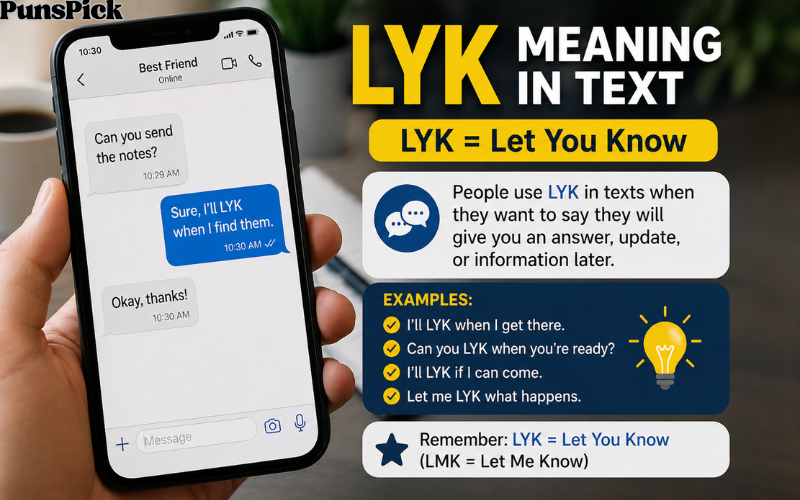
If you have received a text that says “LYK”, you may be wondering what those three letters mean. Texting abbreviations can make casual conversations much shorter, but they can also be confusing when you come across one you have never seen before.
In texting and online conversations, LYK usually means “let you know.” It is commonly used when someone wants to tell another person that they will provide information, an answer, an update, or a decision later.
For example:
“I’ll LYK tomorrow.”
means:
“I’ll let you know tomorrow.”
You may also see LYK in messages such as:
- “I’ll LYK when I get there.”
- “Let me LYK.”
- “I’ll LYK what happens.”
- “I’ll LYK if I can come.”
- “Can you LYK when you’re ready?”
The abbreviation is casual and is especially common in text messages, social media conversations, group chats, and direct messages.
In this guide, I’ll explain LYK meaning in text, what it stands for, how people use it, what it means in different situations, how to respond, whether it has a romantic meaning, and how it compares with similar texting abbreviations.
Related Post: GM Meaning in Text: What Does GM Mean in a Text Message?
What Does LYK Mean in Text?
LYK means “Let You Know.”
It is a shortened form of the phrase “let you know.” People use it when they want to say that they will provide information later.
For example:
“I’ll LYK tonight.”
The full sentence is:
“I’ll let you know tonight.”
Another example is:
“I’ll LYK when I find out.”
This means:
“I’ll let you know when I find out.”
LYK is usually not a complete sentence by itself. It normally appears as part of a longer message.
You might see:
“I’ll LYK.”
or:
“Can you LYK?”
The exact meaning depends on the rest of the sentence.
What Does LYK Stand For?
LYK stands for:
“Let You Know.”
The abbreviation comes from the first letters of the words:
| Letter | Word |
| L | Let |
| Y | You |
| K | Know |
So:
LYK = Let You Know
Unlike some abbreviations that represent an entire phrase, LYK is often used as a replacement for the words “let you know” inside a sentence.
For example:
“I’ll let you know later.”
can become:
“I’ll LYK later.”
The meaning remains the same.
What Is the Simple Meaning of LYK?
The simplest way to understand LYK is:
LYK = Let You Know
It usually means that someone will give you an answer, update, decision, or piece of information later.
For example:
“I’m not sure if I can make it. I’ll LYK.”
The person is saying:
“I’m not sure if I can make it. I’ll let you know.”
This often means the person does not have enough information to give you a definite answer right now.
They may need to check their schedule, ask someone else, find out more information, or simply make a decision before responding.
How Is LYK Used in Text Messages?
LYK is commonly used when someone wants to postpone giving a definite answer.
For example:
Person 1: “Are you coming to dinner tonight?”
Person 2: “Not sure yet. I’ll LYK.”
The second person is saying that they do not know yet but will provide an answer later.
Another example:
Person 1: “Do you know what time the movie starts?”
Person 2: “No, but I’ll LYK.”
Here, the person plans to find out and then provide the information.
LYK is useful because it keeps a message short while still making the intention clear.
Why Do People Use LYK Instead of “Let You Know”?
The main reason is convenience.
Texting is usually informal, and people often shorten familiar phrases. Instead of typing:
“I’ll let you know when I get home.”
someone might type:
“I’ll LYK when I get home.”
The meaning is immediately recognizable to people who are familiar with the abbreviation.
LYK can also make a message feel more casual.
Compare:
“I will let you know when I have more information.”
with:
“I’ll LYK when I know more.”
The second sounds more natural in a quick text between friends.
LYK Meaning in a Conversation
The meaning of LYK generally stays the same in most conversations: “let you know.”
However, the information being promised can be different.
For example:
“I’ll LYK if I can come.”
means the person will tell you whether they can attend.
“I’ll LYK when I arrive.”
means the person will send you an update after arriving.
“I’ll LYK what I decide.”
means the person will tell you their decision later.
“I’ll LYK the price.”
means the person will find out the price and tell you.
So, while the abbreviation has a simple definition, the actual information being communicated depends on the rest of the message.
LYK Meaning When Someone Is Unsure
One of the most common situations for LYK is uncertainty.
If someone does not have an answer yet, they may say:
“I’ll LYK.”
This tells you that they are not ready to give a definite answer.
For example:
“Can you come with us tomorrow?”
“I’m not sure. I’ll LYK later.”
This does not necessarily mean yes or no. It means the person needs more time or information before deciding.
That distinction is important.
If someone says “I’ll LYK,” you should generally not interpret it as an agreement.
They are simply saying they will update you.
LYK Meaning When Making Plans
LYK is very common when people are making plans.
For example:
“I need to check my schedule. I’ll LYK.”
Or:
“I’m waiting to hear from my brother. I’ll LYK when I know.”
Or:
“Let me check with everyone and I’ll LYK.”
In these situations, the sender is not confirming the plan yet.
They are saying that they will provide an update once they have more information.
LYK Meaning in Group Chats
LYK can also be useful in group chats.
Imagine several friends are planning a weekend trip.
Friend 1: “Are you staying Saturday night?”
Friend 2: “I need to check with my parents. I’ll LYK.”
This means Friend 2 will give everyone an answer later.
Another example:
“I’m checking the hotel prices. I’ll LYK.”
The person is promising to provide an update once they have checked the information.
Because group chats often move quickly, abbreviations such as LYK can make messages easier to type.
LYK Meaning When Making Arrangements
People often use LYK when arranging meetings, appointments, trips, meals, or other activities.
For example:
“I’ll LYK what time I can meet.”
This means the person needs to determine their availability before confirming a time.
Another example:
“I’ll LYK if I can pick you up.”
This means the person will confirm later whether they are able to provide transportation.
The important point is that LYK usually indicates a future update rather than an immediate answer.
LYK Meaning on Social Media
LYK is also used on social media and messaging platforms.
You might see it in direct messages, comments, group conversations, or casual posts.
For example:
“I’ll LYK when the tickets go on sale.”
Or:
“I’ll LYK if I hear anything.”
Or:
“Let me LYK what you think.”
The abbreviation has the same basic meaning online as it does in texting.
It is simply a short way to write “let you know.”
LYK Meaning in a Text From a Friend
If a friend sends you:
“I’ll LYK.”
they usually mean that they will update you later.
The reason for the update could be anything.
Maybe they need to:
- Check their schedule
- Ask someone a question
- Confirm a reservation
- Find out a price
- Make a decision
- Check whether something is available
- Wait for another person’s response
- Get more information
For example:
You: “Are we still going to the beach tomorrow?”
Friend: “I’ll LYK tonight.”
Your friend is not necessarily saying the trip is canceled. They simply do not have a final answer yet.
LYK Meaning in a Text From a Crush
If someone you like sends you “I’ll LYK,” it generally has the same basic meaning.
It means:
“I’ll let you know.”
For example:
You: “Do you want to meet this weekend?”
Them: “I need to check my schedule. I’ll LYK.”
This does not automatically mean they are interested or uninterested romantically.
It simply means they will provide an answer later.
I would avoid reading a romantic message into LYK itself. The surrounding conversation and the person’s behavior are much better indicators of their intentions.
Does LYK Have a Romantic Meaning?
No, LYK does not have a specific romantic meaning.
It is a general texting abbreviation.
Someone may use LYK while talking to:
- A friend
- A family member
- A coworker
- A partner
- A crush
- A classmate
- An online acquaintance
For example:
“I’ll LYK when I get home ❤️”
may appear romantic because of the heart emoji and the relationship between the people.
However, LYK itself simply means “let you know.”
The emotional meaning comes from the rest of the conversation.
Is LYK a Positive or Negative Message?
LYK is generally neutral.
It does not automatically mean something positive or negative.
For example:
“I’ll LYK if I can come.”
is neutral.
The person has not decided yet.
“I’ll LYK when I get there.”
is also neutral.
They are simply promising an update.
However, tone can change depending on the situation.
If someone repeatedly says:
“I’ll LYK.”
without ever following up, you might eventually feel that they are avoiding giving you an answer.
That is not because LYK has a negative meaning. It is because of the person’s behavior in the conversation.
Is LYK Rude?
LYK is not inherently rude.
It is a normal casual abbreviation.
However, the way it is used can affect how a message feels.
For example:
“I’ll LYK.”
can sound perfectly normal.
But if someone responds to several questions with only:
“LYK.”
it could feel brief or dismissive depending on the situation.
If you want to sound warmer, you could write:
“I’m not sure yet, but I’ll let you know as soon as I find out.”
The meaning is similar, but the tone is more detailed.
Is LYK Formal or Informal?
LYK is informal texting language.
It is suitable for:
- Text messages
- Group chats
- Social media
- Direct messages
- Casual emails
- Conversations with friends
- Informal online communities
I would generally avoid using LYK in formal documents or professional communication unless the workplace has a very casual communication style.
For example, instead of:
“I’ll LYK once the report is finished.”
a professional email could say:
“I’ll let you know once the report is finished.”
The full phrase is clearer and more appropriate in formal situations.
Related Post: What Does WYGG Mean in Text? Meaning, Uses, Examples, and More
Can I Use LYK at Work?
You can, but it depends on the workplace.
If your team regularly uses casual abbreviations in internal chats, something like:
“I’ll LYK after the meeting.”
may be completely acceptable.
However, if you are writing to a customer, client, manager, or external business contact, I would usually spell it out.
For example:
“I’ll let you know after the meeting.”
This sounds professional while keeping the message short.
The abbreviation is not grammatically wrong in a text, but it is less formal.
LYK vs. LMK
One of the most important abbreviations to understand alongside LYK is LMK.
LMK means:
“Let Me Know.”
LYK means:
“Let You Know.”
They are almost opposites in terms of who is expected to provide the information.
For example:
“LMK when you get home.”
means:
“Let me know when you get home.”
The sender wants you to provide the update.
But:
“I’ll LYK when I get home.”
means:
“I’ll let you know when I get home.”
The sender will provide the update.
This is an easy distinction to remember:
LMK = You tell me.
LYK = I tell you.
LYK vs. TTYL
LYK and TTYL can both relate to future communication, but they have different meanings.
LYK = Let You Know
TTYL = Talk To You Later
For example:
“I’ll LYK when I have an answer.”
means the person will provide information later.
“I have to go. TTYL.”
means the person will talk to you again later.
LYK focuses on providing information.
TTYL focuses on ending the current conversation and talking again later.
LYK vs. FYI
LYK and FYI also have different purposes.
FYI = For Your Information
It is used to give someone information.
For example:
“FYI, the meeting starts at 3.”
LYK means:
“Let You Know.”
For example:
“I’ll LYK when the meeting starts.”
The difference is simple:
FYI = I am giving you information now.
LYK = I will give you information later.
LYK vs. IDK
IDK means “I Don’t Know.”
This is often connected to LYK because someone may use both abbreviations in the same conversation.
For example:
“IDK what time I’ll arrive. I’ll LYK.”
This means:
“I don’t know what time I’ll arrive. I’ll let you know.”
IDK communicates uncertainty.
LYK communicates a future update.
LYK vs. ASAP
ASAP means “As Soon As Possible.”
It generally expresses urgency.
For example:
“Send me the document ASAP.”
means the sender wants the document as quickly as possible.
LYK does not necessarily communicate urgency.
“I’ll LYK tomorrow.”
simply means the sender will provide an update tomorrow.
These abbreviations serve different purposes.
How Do I Respond to LYK?
Your response depends on the situation.
If someone says:
“I’ll LYK.”
you can simply reply:
- “Okay.”
- “Sounds good.”
- “Sure.”
- “No problem.”
- “Thanks.”
- “Alright, let me know.”
- “Okay, keep me posted.”
- “Sounds good, talk later.”
If you need an answer by a particular time, you can politely explain that.
For example:
“Okay, just let me know by tonight if possible.”
This keeps the conversation clear.
What Does “I’ll LYK” Mean?
“I’ll LYK” means “I’ll let you know.”
This is probably the most common sentence structure you’ll see with the abbreviation.
For example:
“I don’t know yet, but I’ll LYK.”
means:
“I don’t know yet, but I’ll let you know.”
The person is telling you that they will provide an answer or update later.
What Does “Let Me LYK” Mean?
This wording can be confusing because LYK already contains “you.”
If someone writes:
“Let me LYK.”
they may be trying to say something like “let me know”, but that would normally be LMK, not LYK.
The standard abbreviations are:
LMK = Let Me Know
LYK = Let You Know
So if someone writes “Let me LYK,” it may be a mistake, an unusual personal abbreviation, or an informal combination.
Context matters.
What Does “Can You LYK?” Mean?
“Can you LYK?” is less common because LYK normally refers to the speaker letting someone else know.
If someone writes this, they may have confused LYK with LMK.
For example:
“Can you LYK when you’re free?”
The person probably means:
“Can you let me know when you’re free?”
The standard abbreviation would be:
“Can you LMK when you’re free?”
This is a good example of why abbreviations can sometimes be confusing.
What Does “I’ll LYK Later” Mean?
“I’ll LYK later” means “I’ll let you know later.”
It tells you that the person does not have an answer right now but expects to provide one at some point later.
For example:
“I need to check my schedule. I’ll LYK later.”
The person will update you after checking.
What Does “I’ll LYK Soon” Mean?
“I’ll LYK soon” means “I’ll let you know soon.”
This suggests that the person expects to provide an answer relatively soon.
However, “soon” is not a precise time.
It could mean:
- In a few minutes
- Later today
- After a meeting
- Once they find something out
- When they have time
The exact timing depends on the context.
Examples of LYK in Text Messages
Here are some natural examples showing how LYK is used.
Example 1: Making Plans
Person 1: “Are you free tomorrow?”
Person 2: “I need to check. I’ll LYK tonight.”
Meaning:
“I’ll let you know tonight.”
Example 2: Asking About Dinner
Person 1: “Do you want to go out for dinner?”
Person 2: “Not sure yet. I’ll LYK.”
Meaning:
“I’ll let you know.”
Example 3: Checking Availability
Person 1: “Can you pick me up at 7?”
Person 2: “I’ll LYK after work.”
Meaning:
“I’ll let you know after work.”
Example 4: Waiting for Information
Person 1: “Did they approve the request?”
Person 2: “I haven’t heard yet. I’ll LYK when I know.”
Meaning:
“I’ll let you know when I know.”
Example 5: Shopping
Person 1: “Are you buying that jacket?”
Person 2: “I’m still deciding. I’ll LYK.”
Meaning:
“I’ll let you know once I decide.”
Example 6: Travel
Person 1: “What time does your flight land?”
Person 2: “I need to check the updated schedule. I’ll LYK.”
Meaning:
“I’ll let you know.”
Example 7: Casual Conversation
Person 1: “Let me know if you need anything.”
Person 2: “Thanks, I’ll LYK.”
Here, the second person is saying they will provide an update if they need something.
How to Use LYK Correctly
If you want to use LYK in your own messages, the most natural pattern is:
“I’ll LYK…”
For example:
“I’ll LYK tomorrow.”
“I’ll LYK when I get home.”
“I’ll LYK after I check.”
“I’ll LYK if anything changes.”
“I’ll LYK once I know more.”
This makes it clear that you are the person who will provide the information.
If you are asking another person to update you, LMK is normally the better abbreviation.
For example:
“LMK when you arrive.”
not:
“LYK when you arrive.”
Common Mistakes With LYK
The most common mistake is confusing LYK with LMK.
Remember:
LYK = Let You Know
LMK = Let Me Know
Another mistake is assuming LYK means that the person already knows the answer.
Usually, it means the opposite.
If someone says:
“I’ll LYK.”
they often do not have the answer yet.
They are saying they will provide it later.
Another mistake is treating LYK as a formal abbreviation. It is primarily casual digital shorthand.
Is LYK Used by Teenagers?
LYK can be used by teenagers and adults, especially people who regularly communicate through text messages and social media.
However, texting slang varies greatly between individuals and age groups.
Some people use many abbreviations, while others prefer complete sentences.
That means you should not assume that everyone will understand LYK immediately.
If you are texting someone who does not usually use internet slang, writing “I’ll let you know” may be clearer.
Is LYK Still Used Today?
Yes. LYK is still used in casual digital communication.
You may encounter it in:
- Text messages
- Instagram messages
- TikTok comments or messages
- Group chats
- Facebook messages
- Gaming chats
- Online communities
- Casual emails
Its exact popularity varies from one platform or group to another, but the meaning “let you know” remains straightforward.
Does LYK Mean “Love You, Kid”?
In some unusual contexts, people may create their own meanings for abbreviations, but LYK commonly means “let you know” in texting.
You should not automatically interpret LYK as a romantic phrase or another personal expression.
If the conversation does not make sense with “let you know,” check the surrounding messages or ask the sender.
Texting abbreviations are informal, so personal usage can vary.
Related Post: FWIW Meaning in Text: What Does FWIW Mean in a Text Message?
FAQs
What does LYK mean in text?
LYK usually means “Let You Know.” It is used when someone wants to tell another person that they will provide information, an answer, or an update later.
What does LYK stand for?
LYK stands for “Let You Know.”
What does “I’ll LYK” mean?
“I’ll LYK” means “I’ll let you know.” The person is saying that they will provide an answer or update later.
Is LYK a texting abbreviation?
Yes. LYK is informal texting shorthand commonly used in text messages, social media, group chats, and online conversations.
Is LYK the same as LMK?
No. LYK means “Let You Know,” while LMK means “Let Me Know.” LYK usually means the sender will provide the information, while LMK asks the other person to provide information.
Is LYK formal?
No. LYK is generally informal. It is best suited to casual communication rather than formal documents or professional writing.
Does LYK have a romantic meaning?
No. LYK does not have a standard romantic meaning. Someone can use it while talking to a romantic partner or crush, but the abbreviation itself simply means “let you know.”
Conclusion
LYK means “Let You Know.” It is a common casual abbreviation used when someone wants to tell you that they will provide information, an answer, decision, or update later.
The easiest example is:
“I’ll LYK.”
This simply means:
“I’ll let you know.”
You may see LYK when people are making plans, checking schedules, waiting for information, deciding what to do, or trying to confirm something.
For example:
“I’m not sure if I can come. I’ll LYK tonight.”
The person is not saying yes or no. They are saying that they will give you an answer later.
One of the most important abbreviations to keep separate from LYK is LMK. Remember:
LYK = Let You Know
LMK = Let Me Know
If someone says “I’ll LYK,” they are promising to update you. If someone says “LMK,” they are asking you to update them.
LYK is informal, so I would use it mainly in texts, social media messages, group chats, and casual conversations. In formal writing, spelling out “let you know” is usually the better choice.
If you see LYK in a message, you can generally understand it as:
LYK = Let You Know
In simple terms, the sender is saying:
“I’ll give you the information when I have it.”