
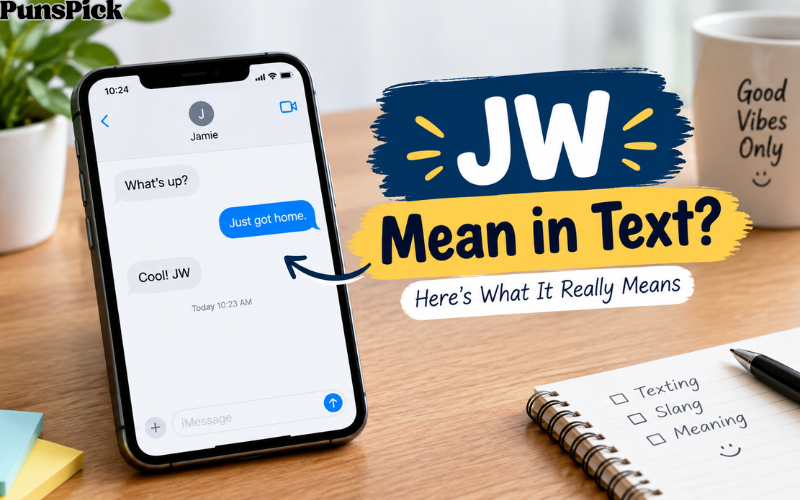
If someone sends me “JW” in a text message, I usually look at the rest of the conversation before deciding what it means. The reason is simple: JW can have more than one meaning, and the intended meaning depends heavily on the context.
In casual texting, social media conversations, and online chats, JW most commonly means “just wondering.” People use it when they want to ask something without making the question sound too serious, demanding, or personal.
For example, someone might text:
“JW, are you coming tonight?”
Here, “JW” means “just wondering.”
However, JW can also mean other things. In some conversations, it may mean “just wait,” while in religious discussions, JW can refer to a Jehovah’s Witness. It can also be someone’s initials, a username abbreviation, a name abbreviation, or a term specific to a particular community.
In this article, I’ll explain what JW means in text, how people use it, what it means in different situations, and how I can tell which definition someone intends.
Related Post: What Does SNM Mean in Text? Meaning, Uses, Examples, and More
What Does JW Mean in Text?
The most common meaning of JW in text messages is “just wondering.”
People often use JW before a question when they want to make it clear that they are simply curious. It can make a message feel more casual and less demanding.
For example:
- “JW, what time are you leaving?”
- “JW, did you talk to Sarah?”
- “JW, are you still coming?”
- “JW, how did the meeting go?”
- “JW, why did you leave early?”
In each of these examples, JW means “just wondering.”
When I see “JW” at the beginning of a casual question, I would normally interpret it as “just wondering,” especially when there is no other context suggesting a different meaning.
The abbreviation is useful because typing “just wondering” takes more time than typing two letters. Texting culture has made short abbreviations common, especially in quick conversations.
JW Meaning in Text at a Glance
Here is a quick look at the most common meanings of JW:
| JW Meaning | Where It Is Common | Example |
| Just wondering | Texting and casual chats | “JW, are you free later?” |
| Just wait | Casual messages | “JW, I’ll explain.” |
| Jehovah’s Witness | Religious conversations | “My friend is a JW.” |
| Initials | Names and personal references | “JW sent me the file.” |
| Username abbreviation | Online communities | “JW commented on the post.” |
The important thing to remember is that “just wondering” is generally the most likely meaning in ordinary texting, but context always matters.
What Does JW Stand for in Texting?
In everyday texting, JW usually stands for “just wondering.”
I might use it when I want to ask a question but do not want the other person to think I am making a serious accusation or demanding an explanation.
For example:
“JW, why didn’t you reply earlier?”
This can sound softer than:
“Why didn’t you reply earlier?”
The first version suggests that the sender is simply curious. The second version may sound more direct or confrontational depending on the relationship between the two people.
Another example is:
“JW, did you already buy the tickets?”
The person may not be upset if the tickets have already been purchased. They are simply asking because they want to know.
This is one reason the abbreviation is so common in informal conversations.
JW Means “Just Wondering”
The phrase “just wondering” is used when someone wants information without putting too much pressure on the other person.
I might use JW when:
- I am curious about something.
- I want to ask a follow-up question.
- I do not want my question to sound demanding.
- I want to check something casually.
- I am unsure about a situation.
- I want to know someone’s plans.
- I want an explanation but want to keep the tone relaxed.
For example:
“JW, what made you choose that restaurant?”
The person isn’t necessarily criticizing the choice. They may simply want to know why the restaurant was selected.
Similarly:
“JW, are you working tomorrow?”
This is simply a casual way of asking about someone’s schedule.
Examples of JW Meaning “Just Wondering”
Here are some realistic examples of how JW appears in text messages.
Example 1
Person A: “JW, are you still going to the party?”
Meaning: “Just wondering, are you still going to the party?”
Example 2
Person A: “JW, did you finish the project?”
Meaning: “Just wondering, did you finish the project?”
Example 3
Person A: “JW, why did you change your profile picture?”
Meaning: “Just wondering, why did you change your profile picture?”
Example 4
Person A: “JW, do you know where Tom is?”
Meaning: “Just wondering, do you know where Tom is?”
Example 5
Person A: “JW, are we meeting at 6 or 7?”
Meaning: “Just wondering, are we meeting at 6 or 7?”
In all of these examples, JW simply introduces a casual question.
Why Do People Use JW Instead of “Just Wondering”?
The main reason is convenience.
Text messages are designed around quick communication. People naturally shorten common expressions to save time and effort. Over time, abbreviations such as LOL, BRB, IDK, BTW, FYI, and JW have become familiar to many people.
There is also a tone advantage.
When I write:
“JW, did you tell Mike?”
it can feel more relaxed than:
“Did you tell Mike?”
The abbreviation can signal that I am asking out of curiosity rather than demanding an answer.
That does not mean JW automatically makes a message friendly. Tone still depends on the situation, punctuation, relationship, and subject of the conversation.
For example:
“JW, why were you talking about me?”
can still sound suspicious or confrontational.
So, JW can soften a question, but it does not completely change the meaning or emotional tone of the message.
JW Meaning in Text From a Friend
When a friend sends me “JW,” I would usually assume they mean “just wondering.”
For example:
“JW, what are you doing this weekend?”
A friend may simply be trying to find out your plans.
Another example:
“JW, did you ever try that new restaurant?”
Again, the sender is likely just curious.
In conversations between friends, JW often appears at the beginning of a sentence. It can be written in uppercase as “JW,” lowercase as “jw,” or sometimes as part of a longer message.
For example:
- “jw if you’re coming”
- “JW, are you busy?”
- “Hey, jw what happened yesterday?”
All three can have the same basic meaning.
JW Meaning in Text From a Girl
If a girl sends “JW” in a text, the abbreviation itself does not have a special meaning simply because she is a girl.
In most casual conversations, JW still means “just wondering.”
For example:
“JW, do you like her?”
This means:
“Just wondering, do you like her?”
The interesting part is often not the abbreviation itself but the question that follows it.
If someone asks a personal question after saying JW, they may be genuinely curious, trying to start a conversation, or attempting to ask something indirectly. I would look at the entire conversation rather than assuming that JW signals romantic interest.
JW Meaning in Text From a Guy
The same applies when a guy uses JW.
If he writes:
“JW, are you going to the game?”
JW most likely means “just wondering.”
It does not automatically indicate flirting, romantic interest, or anything hidden.
The surrounding conversation provides much more information than the abbreviation alone.
For example:
“JW, are you going with anyone?”
could be an ordinary question about plans, or it could have a more personal purpose. I would need to consider the previous messages and relationship between the two people to understand the intended tone.
Does JW Mean “Just Wondering” or “Just Wait”?
Another possible meaning of JW is “just wait.”
This meaning is less universal than “just wondering,” so I would not automatically assume it whenever I see JW.
For example:
“JW, I’ll send it to you.”
Depending on the conversation, the sender may intend “just wait.”
A clearer example would be:
“JW, don’t leave yet.”
If the surrounding messages are about waiting for something, JW could mean “just wait.”
However, if JW appears directly before a question, “just wondering” is usually a more natural interpretation.
For example:
“JW, where did you get that?”
almost certainly makes more sense as:
“Just wondering, where did you get that?”
Context is therefore the best way to distinguish between the possible meanings.
JW Meaning as Jehovah’s Witness
JW can also refer to a Jehovah’s Witness, particularly in religious discussions.
For example:
“He is a JW.”
In this context, JW does not mean “just wondering.” It refers to a member of the Jehovah’s Witnesses religious community.
You may see this meaning in conversations about:
- Religion
- Bible study
- Religious beliefs
- Church communities
- Door-to-door preaching
- Religious history
- Personal religious experiences
For example:
“My neighbor is a JW.”
Here, the meaning is completely different from casual texting.
This is a good example of why I should not interpret an abbreviation without considering the subject of the conversation.
How to Know Which JW Meaning Someone Intended
When I receive a message containing an abbreviation, I look at several clues.
1. Look at the sentence
The sentence itself often gives away the meaning.
“JW, what time is the meeting?”
This strongly suggests “just wondering.”
On the other hand:
“My uncle is a JW.”
is more likely referring to Jehovah’s Witness.
2. Look at the conversation topic
If the conversation is about plans, relationships, school, work, or everyday activities, “just wondering” is a strong possibility.
If the conversation is about religion, JW may have a completely different meaning.
3. Look at where JW appears
JW at the beginning of a question often means “just wondering.”
For example:
“JW, did you get home safely?”
If JW appears as a noun or description of a person, another meaning may be intended.
For example:
“She’s a JW.”
4. Consider who sent it
A friend may use JW casually, while a religious discussion group may use JW differently.
5. Read the messages before and after it
This is often the easiest way to understand an abbreviation.
One two-letter abbreviation can have several meanings, but the conversation around it usually provides enough clues.
Is JW a Slang Word?
I would describe JW as a texting abbreviation rather than traditional slang.
It is a shortened form of a phrase, similar to many other abbreviations commonly used in digital communication.
People may use JW in:
- Text messages
- Social media
- Group chats
- Direct messages
- Online forums
- Gaming chats
- Informal emails
It is generally casual rather than formal.
For professional writing, I would normally spell out “just wondering” instead of using JW unless the abbreviation is already accepted within that particular workplace or conversation.
Related Post: What Does WYGG Mean in Text? Meaning, Uses, Examples, and More
Is JW Appropriate for Formal Messages?
Usually, I would avoid using JW in formal communication.
For example, if I am emailing a manager, teacher, client, or business contact, I would write:
“I was just wondering if the meeting time has changed.”
rather than:
“JW if the meeting time changed.”
The full phrase is clearer and more professional.
JW works better in casual communication where abbreviations are expected.
Casual example
“JW, are you free tonight?”
More formal example
“I was just wondering whether you are available this evening.”
Both communicate curiosity, but the second is more appropriate for a formal setting.
JW vs. “Just Wondering”
There is no major difference in basic meaning between JW and “just wondering.”
The main difference is style.
| JW | Just Wondering |
| Short | Full phrase |
| Casual | Neutral |
| Fast to type | More polished |
| Common in texting | Suitable for more situations |
| Informal | Can work in formal writing |
If I am chatting with a friend, JW is perfectly natural.
If I am writing something professional, I would normally use the complete phrase.
Common Texting Examples With JW
Here are more examples that show how JW can be used naturally.
- “JW, what time should I come over?”
- “JW, did you already eat?”
- “JW, are you going tomorrow?”
- “JW, where did you buy that?”
- “JW, have you heard from Alex?”
- “JW, are we still meeting today?”
- “JW, did you see my message?”
- “JW, what happened at work?”
- “JW, are you free later?”
- “JW, did you finish watching it?”
- “JW, why did you delete the post?”
- “JW, do you know the answer?”
- “JW, are you coming with us?”
- “JW, what are your plans?”
- “JW, did you call Mom?”
In each example, JW can naturally be expanded to “just wondering.”
What Does “JW?” Mean by Itself?
If someone sends only:
“JW?”
the meaning becomes less certain.
If there is no other context, I would not confidently assume a single definition.
It could be someone’s initials, a reference to a person, an abbreviation used within a particular group, or an incomplete message.
If the person normally uses JW to mean “just wondering,” they may have accidentally sent an incomplete message.
The safest response is often to ask:
“What do you mean by JW?”
There is nothing wrong with asking for clarification when an abbreviation is unclear.
What Does JW Mean on Social Media?
On social media, JW can have several meanings depending on the community and the post.
In ordinary comments or direct messages, “just wondering” is a likely meaning when JW introduces a question.
For example:
“JW, where did you get this?”
means:
“Just wondering, where did you get this?”
But social media is also full of specialized communities. A religious discussion may use JW to refer to Jehovah’s Witnesses.
That is why the topic of the post matters.
JW in Online Conversations
Online conversations often use abbreviations because people want to respond quickly.
A person might write:
“jw if anyone knows how to fix this”
instead of:
“Just wondering if anyone knows how to fix this.”
This style is particularly common in informal posts and chat rooms.
People also use lowercase forms such as jw because many messaging platforms do not require capitalization.
So these can all communicate the same idea:
- JW
- jw
- “just wondering”
The capitalization generally does not change the basic meaning.
Common Mistakes When Interpreting JW
One mistake is assuming that every abbreviation has only one meaning.
That can cause confusion because abbreviations depend on context.
For example, if someone says:
“JW, what happened?”
interpreting JW as Jehovah’s Witness would make the sentence confusing.
Another mistake is assuming that JW always means “just wondering” even when the conversation is clearly about religion.
For example:
“My cousin is a JW.”
In that sentence, “just wondering” does not make sense.
The best approach is to look at the entire message rather than translating the abbreviation by itself.
How I Would Reply to a Message Containing JW
If I understand JW as “just wondering,” I would simply answer the question.
For example:
Friend: “JW, are you coming tonight?”
Reply: “Yeah, I’ll be there around 8.”
There is no need to mention the abbreviation.
If I am unsure about the meaning, I can ask:
“Do you mean just wondering?”
That is especially useful when the abbreviation could reasonably have multiple meanings.
JW in Different Contexts
The meaning of JW can change depending on the setting.
In a casual text
“JW, what are you doing later?”
Meaning: Just wondering
In a religious conversation
“He is a JW.”
Meaning: Jehovah’s Witness
In a message about a person
“JW sent me the document.”
Meaning: Likely someone’s initials
In a conversation about waiting
“JW, I’ll be there.”
Meaning: Possibly just wait, depending on context
This comparison shows why context is so important.
Is JW Rude in Texting?
No, JW is not inherently rude.
When it means “just wondering,” it is usually a casual and neutral way to introduce a question.
However, the question itself can determine whether the message sounds friendly, intrusive, suspicious, or confrontational.
For example:
“JW, are you okay?”
sounds caring.
But:
“JW, why were you lying?”
can sound accusatory.
The abbreviation does not control the entire tone of the message.
Can JW Be Used in a Conversation With Someone You Like?
Yes. People can use JW in conversations with friends, family members, coworkers, classmates, or romantic interests.
For example:
“JW, are you seeing anyone?”
The abbreviation still means “just wondering.”
The question may have a personal or romantic purpose, but that comes from the content of the question rather than from JW itself.
I would avoid assuming someone’s feelings based only on the use of this abbreviation.
JW Meaning in Different Age Groups
Texting habits vary from person to person.
Some people use abbreviations frequently, while others prefer complete sentences. Younger users may be more comfortable with short forms, but there is no strict age rule for using JW.
Someone who frequently sends abbreviations may write:
“jw if u wanna come”
while another person might write:
“Just wondering if you want to come.”
Both can mean exactly the same thing.
The communication style depends more on personal preference than age alone.
Related Post: JP Meaning in Text: What Does JP Mean in a Text Message?
FAQs
What does JW mean in text?
In casual texting, JW most commonly means “just wondering.” It is often placed before a question to show that someone is simply curious.
What does JW stand for in a text message?
JW usually stands for “just wondering” when used in an informal text message. However, it can have other meanings depending on the conversation.
Does JW mean just wondering?
Yes. “Just wondering” is one of the most common meanings of JW in casual texting, especially when it appears before a question.
Can JW mean just wait?
Yes, JW can sometimes be interpreted as “just wait,” although this meaning is more dependent on context. If JW appears before a question, “just wondering” is generally more likely.
What does JW mean in a religious conversation?
In a religious context, JW can refer to a Jehovah’s Witness. The surrounding conversation usually makes this meaning clear.
Is JW formal or informal?
JW is generally informal. I would use “just wondering” instead in professional emails, formal letters, academic writing, or other situations where a more polished style is appropriate.
What does jw mean in lowercase?
Lowercase “jw” can have the same meaning as uppercase “JW.” In casual texting, it commonly means “just wondering.”
Does JW mean something romantic?
Not by itself. JW does not automatically indicate romantic interest. If someone uses it in a personal question, the romantic meaning would come from the context rather than the abbreviation itself.
How should I respond when someone says JW?
If JW means “just wondering,” simply answer the question that follows it. If the meaning is unclear, ask the sender what they mean.
Is JW a texting abbreviation?
Yes. JW is commonly used as a short form of “just wondering” in informal digital communication.
Conclusion
When I see JW in a normal text conversation, my first interpretation would usually be “just wondering.” It is a simple texting abbreviation that people use to introduce a question or show casual curiosity.
For example:
“JW, are you coming?”
simply means:
“Just wondering, are you coming?”
At the same time, I would not treat “just wondering” as the only possible definition. JW can also mean “just wait,” refer to a Jehovah’s Witness, or represent someone’s initials. The topic, sentence structure, and surrounding messages are the best clues.
The easiest rule I use is this: if JW appears before a casual question, “just wondering” is probably the intended meaning. If JW is being used to describe a person or appears in a religious discussion, another meaning may be more appropriate.
Understanding the context makes these short texting abbreviations much easier to interpret. Once you look at the complete conversation rather than focusing on the two letters alone, the intended meaning is usually quite clear.