
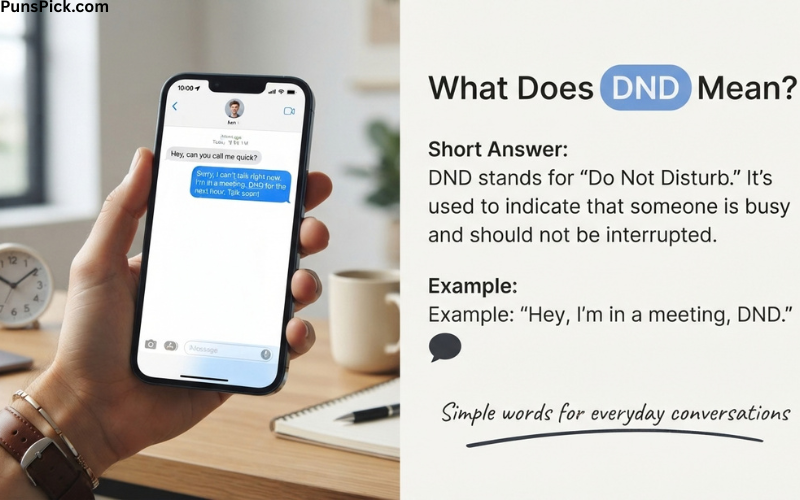
If you have seen DND in a text message, social media post, gaming chat, or phone setting, you may have wondered what it means. In most casual conversations, DND means “Do Not Disturb.” People use it when they do not want to be interrupted, contacted, or disturbed for a certain period.
For example, if someone texts you, “I’m studying, DND,” they are basically saying, “I’m studying, so please don’t disturb me.”
I see DND used in several different ways online. Sometimes it is a quick message between friends. Sometimes it appears as a status on a phone or messaging app. It can also have different meanings depending on the context. In gaming, for example, D&D can refer to Dungeons & Dragons, which is different from DND as “Do Not Disturb.”
In this article, I’ll explain what DND means in text, how people use it, what it means on phones, and how you can understand it from the conversation around it.
What Does DND Mean in Text?
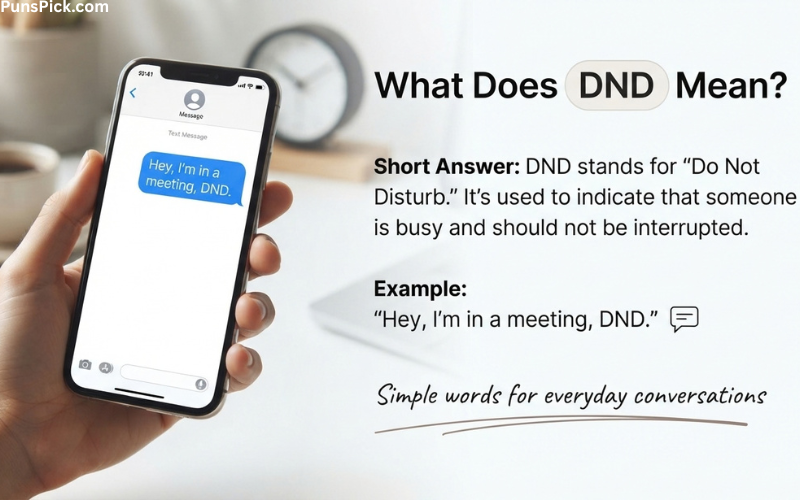
DND usually means “Do Not Disturb” in text messages.
It is commonly used when someone wants some quiet time and does not want to receive calls, messages, notifications, or interruptions.
For example:
“I have an exam tomorrow. DND please.”
This means:
“I have an exam tomorrow. Please do not disturb me.”
DND is short and convenient, which is why people often use it in texting. Instead of typing a full sentence, someone can simply write “DND” and expect the other person to understand.
The exact meaning can depend on the situation. If someone says “DND for the next two hours,” they probably want privacy or uninterrupted time. If you see DND next to a phone icon or status, it may refer to a device setting that blocks or silences notifications.
So, when I see DND in a normal text conversation, I first understand it as Do Not Disturb unless the surrounding conversation suggests another meaning.
DND Meaning in Simple Words
In simple words, DND means “please don’t disturb me.”
Someone might use DND when they are:
- Sleeping
- Studying
- Working
- Driving
- Watching a movie
- In a meeting
- Taking a break
- Spending time alone
- Busy with an important task
- Trying to avoid notifications
For example, a friend might say:
“DND, I’m sleeping.”
They are not necessarily upset with you. They are simply asking you not to interrupt them.
This is one reason DND is so common in digital communication. It communicates a simple request without requiring a long explanation.
Related Post: What Does HYB Mean in Text?
What Does DND Stand For?
DND stands for “Do Not Disturb.”
Each letter comes from the phrase:
- D = Do
- N = Not
- D = Disturb
The abbreviation is easy to remember because it uses the first letter of each word.
You may see it written as:
- DND
- dnd
- Do Not Disturb
- Do not disturb
- DND mode
All of these can refer to the same basic idea in everyday digital communication.
What Does DND Mean on a Phone?
On a smartphone, DND usually means Do Not Disturb mode.
This is a feature that lets you control notifications and interruptions. When DND mode is enabled, your phone can silence or limit certain calls, alerts, messages, and app notifications.
The exact options vary depending on the phone and operating system. Some phones allow you to decide which people or apps can still contact you while DND is active.
For example, I might turn on DND when I need to concentrate. Instead of receiving every notification immediately, I can keep the phone quiet and check my messages later.
A phone may display a moon icon or another symbol when DND is active. The appearance depends on the device.
DND on a phone is therefore slightly different from someone simply typing “DND” in a text. In both cases, though, the basic idea is the same: reduce interruptions.
What Does DND Mean on iPhone?
On an iPhone, DND is associated with Do Not Disturb, which is part of Apple’s Focus features.
When Do Not Disturb is turned on, the iPhone can silence notifications and calls according to the settings selected by the user.
Someone might use it while:
- Sleeping
- Working
- Studying
- Driving
- Exercising
- Attending a meeting
The person can also customize certain settings so that specific people or notifications can still get through.
For example, someone may keep DND enabled overnight but allow calls from family members.
This is useful because “Do Not Disturb” does not always mean that every notification is completely blocked. The behavior depends on the settings.
What Does DND Mean on Android?
On Android phones, DND generally means Do Not Disturb as well.
The feature can reduce interruptions by silencing or controlling calls, notifications, and alerts.
Android devices from different manufacturers can have slightly different menus and options, but the purpose remains similar.
For example, I could schedule DND to turn on automatically during sleeping hours. I could also adjust which notifications are allowed.
If someone tells you, “My phone is on DND,” they are usually letting you know that they may not notice your call or message right away.
That does not necessarily mean they are ignoring you.
DND Meaning in Texting
In texting, DND is usually a quick way to tell another person that you are unavailable or do not want to be interrupted.
Here are some examples:
“DND, I’m working.”
This means the person wants uninterrupted work time.
“Going to sleep. DND.”
This means they do not want messages or calls to disturb them.
“DND for the next hour.”
This means they want to be left alone for the next hour.
“I’m in class rn, DND.”
Here, DND means the person does not want interruptions while they are in class.
The tone can be casual. Friends, coworkers, family members, and online communities may all use the abbreviation.
DND Meaning on Snapchat
On Snapchat, DND can still mean Do Not Disturb.
A person might use the abbreviation in a message or status to tell friends that they do not want interruptions.
For example:
“DND, studying for finals.”
The meaning is straightforward: the person is studying and would prefer not to receive distracting messages.
Some people may also use DND when talking about their phone’s notification settings. The platform does not necessarily change the basic meaning of the abbreviation.
DND Meaning on Instagram
On Instagram, DND usually has the same informal meaning: Do Not Disturb.
Someone might put “DND” in a bio, note, message, or caption to communicate that they are unavailable or want some personal space.
For example:
“DND today. Need some me time.”
The person is asking others not to contact or interrupt them for a while.
If you see DND in an Instagram conversation, look at the surrounding words. They usually make the intended meaning clear.
DND Meaning on WhatsApp
On WhatsApp, DND commonly means Do Not Disturb.
A person may write:
“DND, I’ll reply later.”
This means they are currently unavailable and plan to respond afterward.
You may also see people mention DND when talking about their phone settings.
For example:
“My phone is on DND, so I didn’t see your call.”
Here, DND refers to the phone’s notification setting rather than a direct request to another person.
DND Meaning in Gaming
Gaming is one area where context becomes especially important.
In gaming conversations, DND can sometimes mean “Do Not Disturb,” particularly when a player does not want messages or interruptions while playing.
For example:
“DND while I’m playing ranked.”
The player is asking others not to interrupt them during a competitive game.
However, you should be careful with DND and D&D.
D&D commonly stands for Dungeons & Dragons, the tabletop role-playing game. People sometimes type DND when referring to it, but the standard abbreviation is generally written as D&D.
So if someone says:
“We’re playing D&D tonight.”
They are probably talking about Dungeons & Dragons, not Do Not Disturb.
Context makes the difference.
DND vs. D&D
These abbreviations can look very similar, but they usually refer to different things.
| Abbreviation | Common meaning |
| DND | Do Not Disturb |
| D&D | Dungeons & Dragons |
If someone writes:
“DND, I’m sleeping.”
They mean Do Not Disturb.
If someone writes:
“I bought a new D&D campaign book.”
They mean Dungeons & Dragons.
The ampersand in D&D is an important clue, but context is still the best way to understand what someone means.
How People Use DND in Everyday Conversations
People use DND in many casual situations.
When Sleeping
“Going to bed. DND.”
The person wants uninterrupted sleep.
When Studying
“DND until I finish this chapter.”
They want to concentrate without receiving distractions.
When Working
“DND for the next two hours.”
They are busy with work and do not want interruptions.
When Traveling
“On the flight. DND for now.”
They may not be able to respond to messages.
During a Meeting
“Meeting now, DND.”
They are asking people not to call or message unless something is urgent.
During Personal Time
“DND today. Just relaxing.”
They want some private time away from conversations and notifications.
These examples show why DND is useful. The abbreviation can communicate a boundary quickly without sounding overly formal.
DND Examples in Text Messages
Here are some natural examples of DND in texting:
Example 1
A: “Can I call you?”
B: “Not right now, DND. I’m working.”
Example 2
“DND please. I have an exam tomorrow.”
Example 3
“I’m going to sleep now. DND until morning.”
Example 4
“DND for an hour. I need to finish this project.”
Example 5
“Phone is on DND. I’ll text you when I’m free.”
Example 6
“DND during the movie 😂.”
In each example, DND communicates some form of limited availability.
Is DND Rude?
Not necessarily.
Whether DND sounds rude depends on the wording, relationship, and situation.
For example:
“DND. Busy.”
can sound quite direct.
But:
“Hey, I’m working right now. I have DND on, so I’ll reply later.”
sounds more considerate.
The abbreviation itself is not automatically rude. It is simply a short way of communicating that someone does not want interruptions.
If I receive a message saying “DND,” I would usually treat it as a request for space rather than assuming the person is angry.
Of course, the surrounding conversation matters. If someone uses it during an argument, the meaning may carry a stronger emotional tone.
What Should You Reply to DND?
If someone tells you “DND,” the safest response is usually to respect their request.
You can reply with something simple such as:
“Okay, no problem.”
Or:
“Sure, text me when you’re free.”
If the matter is urgent, you may explain that briefly:
“No problem. I’ll wait. It’s urgent, though, so let me know when you can.”
You generally do not need to keep sending messages after someone has clearly asked for uninterrupted time.
Respecting DND is a simple part of good digital communication.
What Does “DND for a While” Mean?
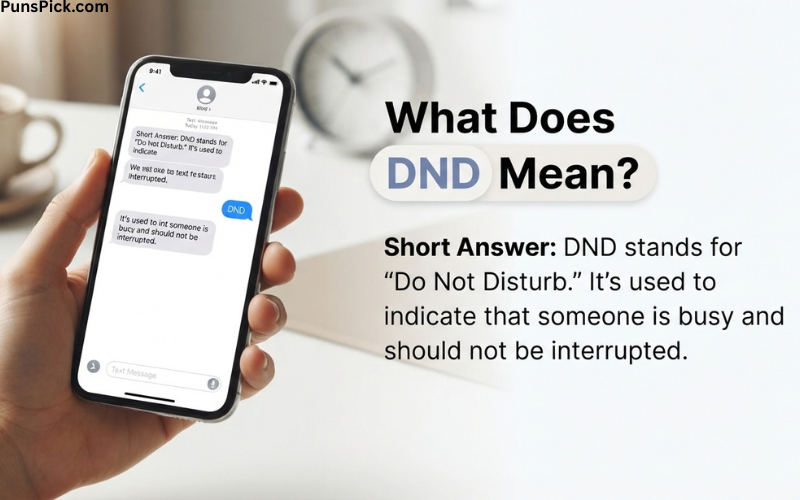
When someone says “DND for a while,” they usually mean they do not want to be disturbed temporarily.
“While” does not give an exact time.
It could mean:
- A few minutes
- An hour
- Several hours
- Until they finish something
- Until they are ready to talk
For example:
“DND for a while, I need some quiet.”
The person is asking for temporary space.
If you need to know when they will be available, you can ask politely:
“Sure. Let me know when you’re free.”
What Does “DND Mode” Mean?
DND mode means Do Not Disturb mode.
You will most often see this phrase when people are talking about phones, tablets, computers, or other devices.
For example:
“I keep my phone in DND mode while studying.”
This means the person activates a setting that reduces notifications or interruptions.
You might also see:
“DND mode activated.”
This can be serious or playful.
Someone might post it online to jokingly announce that they are unavailable.
DND as a Personal Boundary
DND can also be used as a simple way to communicate a personal boundary.
People receive a huge number of notifications every day. Messages, calls, emails, social media alerts, and app notifications can make it difficult to focus.
Writing “DND” tells others:
“I am not available right now.”
That does not automatically mean:
“I don’t want to talk to you ever.”
There is a difference.
Someone may simply need a short break from communication.
For example, a person who works from home might use DND during focused work periods. A student might use it while preparing for an exam. Someone who is sleeping might turn it on overnight.
The meaning is often temporary.
Does DND Mean Ignore Me?
Usually, no.
DND means Do Not Disturb, not necessarily “ignore me forever.”
If someone says:
“DND until 5 PM.”
they are giving you a specific period during which they do not want interruptions.
Once that period ends, they may be available again.
Similarly, if someone’s phone is in DND mode, they may still want to talk to you. They simply do not want notifications interrupting them at that moment.
This distinction is useful because it prevents misunderstandings.
DND Meaning in Social Media Statuses
People sometimes use DND as a short status.
Examples include:
“DND 💤”
“DND — studying.”
“DND until tomorrow.”
“DND. Taking a break.”
“DND mode.”
These statuses are usually meant to communicate availability.
A person may not want to explain why they are unavailable. DND gives them a simple way to communicate it.
DND Meaning in Professional Communication
DND is more common in casual communication than formal business writing.
At work, I would usually write something clearer, such as:
“I’m unavailable until 3 PM.”
or:
“I’m in a meeting and will respond afterward.”
Still, DND can appear in workplace messaging platforms, especially when coworkers are familiar with each other.
For example:
“DND for the next 30 minutes — working on the report.”
This is understandable, but the level of formality depends on the workplace.
Other Possible Meanings of DND
Although Do Not Disturb is the most common meaning in texting and phone settings, DND can have other meanings in different contexts.
The most recognizable alternative is connected to Dungeons & Dragons, usually written as D&D.
There may also be specialized meanings in particular industries, organizations, games, or technical systems.
That is why I would not automatically assume that every appearance of “DND” means Do Not Disturb.
The words around the abbreviation are the best clue.
If the conversation is about notifications, sleeping, working, or privacy, DND almost certainly means Do Not Disturb.
If the conversation is about tabletop gaming, characters, campaigns, dice, or role-playing, the person may be referring to Dungeons & Dragons, although D&D is the more standard form.
FAQs
What is the full form of DND?
The most common full form of DND in texting and phone settings is Do Not Disturb.
What does DND mean in a text message?
DND usually means Do Not Disturb. The person is asking not to be contacted or interrupted for a certain period.
Is DND a slang word?
DND is better described as an abbreviation than traditional slang. People commonly use it in casual digital communication.
What does DND mean on a phone?
DND on a phone means Do Not Disturb mode. It can silence or limit notifications and calls according to the user’s settings.
What does DND mean on social media?
On social media, DND generally means Do Not Disturb. Someone may use it in a status, note, caption, or message to say they are unavailable.
Does DND mean someone is angry?
Not necessarily. DND usually only means that someone does not want to be disturbed. Their tone and the surrounding conversation can provide more context.
What does DND mean from a girl?
If a girl texts you “DND,” the abbreviation generally has the same meaning: Do Not Disturb. It does not have a special meaning simply because the sender is a girl.
What does DND mean from a guy?
If a guy sends “DND,” it generally means Do Not Disturb. The context can tell you whether he is sleeping, working, studying, busy, or simply asking for some space.
What should I say when someone says DND?
A simple response such as “Okay, no problem” is appropriate. If the matter is not urgent, you can wait until they are available.
Is DND the same as ignoring someone?
No. DND usually means the person does not want interruptions at that moment. It does not necessarily mean they intend to ignore you permanently.
What does DND mean in gaming?
In gaming, DND can mean Do Not Disturb, especially when a player does not want interruptions. In some contexts, people may use DND to refer informally to Dungeons & Dragons, though D&D is the standard abbreviation.
What does DND mode mean?
DND mode means Do Not Disturb mode. It is a device feature that helps reduce calls, notifications, and other interruptions.
Conclusion
So, what does DND mean? In most texts, chats, social media messages, and phone settings, DND means “Do Not Disturb.”
People use it when they want uninterrupted time. They may be sleeping, studying, working, attending a meeting, watching something, or simply taking a break.
The abbreviation is short, simple, and easy to understand. It does not automatically mean someone is angry or avoiding you. In many cases, it simply means they are unavailable for the moment.
The context still matters. If you see DND in a conversation about phones or personal availability, “Do Not Disturb” is the natural meaning. If the conversation is about tabletop role-playing games, check whether the person actually means D&D, or Dungeons & Dragons.
When someone tells you “DND,” the simplest approach is to respect their request and give them some space until they are ready to respond.