
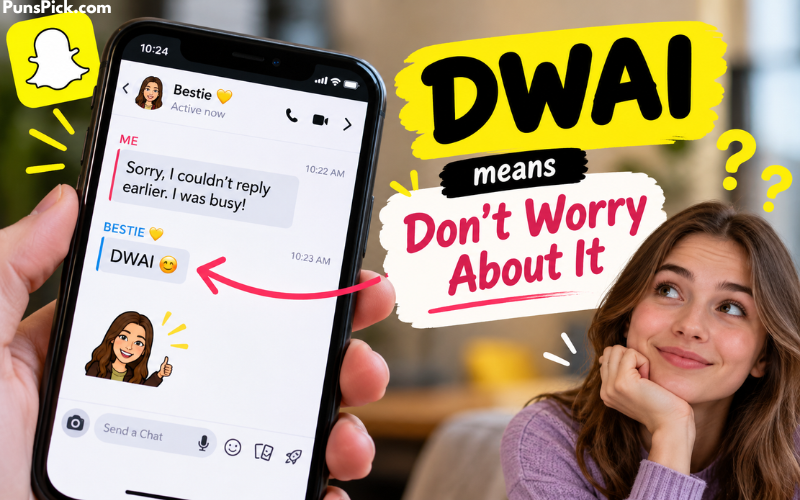
DWAI on Snapchat usually means “Don’t Worry About It.” People use this abbreviation in chats when they want to reassure someone, accept an apology, or show that a small mistake is not a big deal. For example, if you apologize to a friend for replying late and they respond with “DWAI,” they are probably telling you not to worry about the delay.
Snapchat users often use short forms because they make conversations quicker and more casual. DWAI is one of the abbreviations that may appear when friends discuss plans, missed messages, misunderstandings, or everyday problems. It can help keep a conversation relaxed without requiring a long explanation.
However, the exact meaning and tone depend on the situation. A person might use DWAI warmly to reassure you, while another person might use it to end a discussion about something minor. The abbreviation alone cannot tell you everything about the sender’s feelings.
This article explains what DWAI means on Snapchat, how to use it, examples of conversations, similar slang terms, possible interpretations, and suitable replies.
What Does DWAI Stand for on Snapchat?
DWAI commonly stands for “Don’t Worry About It.” It is an informal abbreviation formed from the first letters of the words in the phrase. People use it in digital conversations to tell someone that they do not need to feel concerned about a particular situation.
For example, suppose you forget to send your friend a picture and apologize the next day. Your friend might reply, “DWAI, send it whenever you can.” This means that the forgotten picture is not a serious issue and there is no need to feel guilty about it.
The abbreviation is useful when someone wants to communicate reassurance in just a few letters. Rather than typing the complete phrase, they can send DWAI and continue the conversation.
Here is the breakdown of the abbreviation:
| Letter | Word |
| D | Don’t |
| W | Worry |
| A | About |
| I | It |
DWAI is informal texting language, so it is more common in casual chats than in formal writing. It can appear on Snapchat, WhatsApp, Instagram, and other messaging platforms. Although “Don’t Worry About It” is the common interpretation in everyday conversations, context matters because the same abbreviation can have other meanings in specialized settings.
What Does DWAI Mean in Snapchat Chat?
In Snapchat chats, DWAI generally communicates reassurance or a lack of concern. It is often used after someone apologizes, explains a mistake, or asks whether they have caused an inconvenience. The sender may be telling the other person that the situation is not important enough to worry about.
Imagine that you planned to meet a friend but had to cancel at the last minute. You apologize and explain what happened. If your friend responds, “DWAI, we can meet tomorrow,” they are indicating that changing the plan is acceptable.
DWAI can also help someone move past an awkward moment. A friend might use it after a misunderstanding to show that they do not want a small issue to become a bigger argument.
Common interpretations include:
- Reassurance: The person wants you to stop worrying about the issue.
- Acceptance of an apology: They may be indicating that your mistake is forgiven or unimportant.
- Convenience: They want you to know that a delay or change of plans is acceptable.
- Moving on: They may prefer to continue the conversation rather than discuss a minor problem.
- Reducing pressure: They want you to feel less guilty about an inconvenience.
These interpretations are common, but they are not guarantees of the sender’s emotional state. If the topic is serious or the message seems unclear, reading the full conversation is more useful than relying on DWAI alone.
Why Do People Use DWAI on Snapchat?
People use DWAI because it is short, easy to type, and suitable for casual communication. Snapchat conversations often move quickly between text messages, pictures, videos, and reactions. An abbreviation allows someone to respond without typing a complete sentence.
Another reason people use DWAI is that it can make a conversation feel less formal. When a friend apologizes for a small mistake, a short reassurance may be all that is needed. It prevents a minor issue from turning into a long discussion.
For example, if someone says, “Sorry, I forgot to reply yesterday,” you could answer, “DWAI, I know you were busy.” The message communicates that you understand and that the delay is not a problem.
People may use DWAI for several reasons:
- Saving time: It is quicker than typing the full phrase.
- Reassuring friends: It helps communicate that a small mistake is acceptable.
- Accepting apologies: It can show that the person does not want to dwell on the issue.
- Keeping conversations casual: It fits naturally into informal messages.
- Avoiding unnecessary explanations: It may be enough to settle a minor misunderstanding.
Not everyone uses abbreviations in the same way. Some Snapchat users prefer short responses, while others write complete sentences. The sender’s usual communication style can help you knowing whether DWAI is simply their normal way of texting.
Examples of DWAI in Snapchat Conversations
Examples make it easier to understand how DWAI works in different situations. The abbreviation usually means “Don’t Worry About It,” but the words surrounding it help explain why the person is using it.
Example 1: When You Reply Late
You: Sorry, I was busy and couldn’t reply earlier.
Friend: DWAI, it’s okay.
Your friend is telling you that the delayed reply is not a problem. The additional words make the reassuring meaning clear.
Example 2: When You Send the Wrong Snap
You: Sorry, I sent you the wrong picture.
Friend: DWAI 😂
The friend may be treating the mistake as something minor or funny. The laughing emoji adds a playful tone, although emojis do not always reveal exactly how someone feels.
Example 3: When You Forget Something
You: I forgot to send you the photo yesterday. Sorry!
Friend: DWAI, send it whenever you can.
The friend is communicating that there is no urgency and that the forgotten photo is not a serious issue.
Example 4: When You Cancel Plans
You: Sorry, I can’t come tonight.
Friend: DWAI, maybe tomorrow.
The response suggests that the friend is comfortable changing the plan and does not want you to feel guilty.
Example 5: When You Worry About Someone Being Upset
You: Are you mad at me because I couldn’t join you?
Friend: DWAI, we’re good.
The friend is reassuring you that the missed plan has not necessarily caused a disagreement.
Example 6: When You Make a Small Mistake
You: Sorry, I gave you the wrong information earlier.
Friend: DWAI, thanks for letting me know.
The response indicates that the friend is willing to move past the mistake. They may appreciate the correction without needing a lengthy apology.
These examples show why DWAI is common in casual messaging. It provides a quick way to respond to everyday problems. Still, the surrounding words and the nature of the conversation determine whether the message sounds warm, neutral, or dismissive.
Does DWAI Mean the Same Thing in Every Conversation?
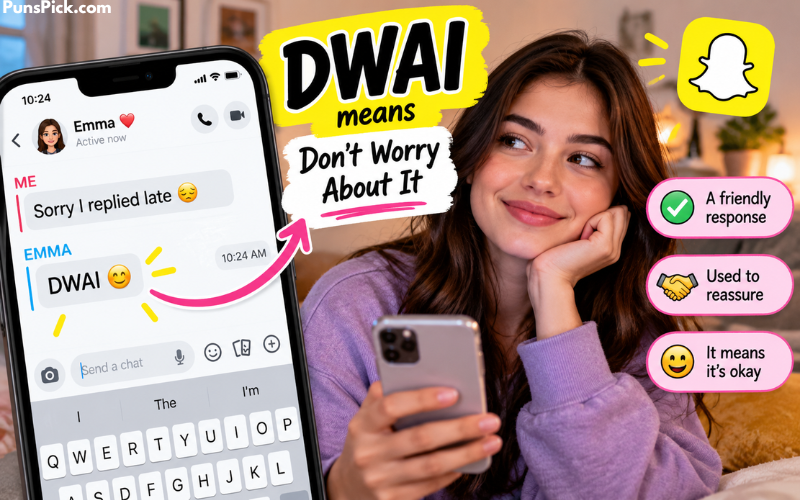
No. DWAI commonly means “Don’t Worry About It” in informal messages, but abbreviations can have different meanings depending on the subject and setting. In ordinary Snapchat conversations, the phrase is usually a form of reassurance. In other contexts, the same letters may refer to something unrelated.
Even when the sender intends “Don’t Worry About It,” the expression can communicate slightly different things. Someone replying after a minor mistake may be accepting an apology. Someone responding after a disagreement may simply want to stop discussing the issue. A short message cannot establish whether the person has completely forgotten the problem or still has concerns.
The following table shows how DWAI may be interpreted in different situations.
| Snapchat Situation | Possible Meaning of DWAI | What It Suggests |
| A friend replies late | Don’t Worry About It | The delay is not a problem. |
| Someone apologizes | Don’t Worry About It | The person may be accepting the apology. |
| You cancel plans | Don’t Worry About It | The other person may be comfortable changing plans. |
| You send the wrong snap | Don’t Worry About It | The mistake may not matter to them. |
| You ask if someone is angry | Don’t Worry About It | They may be trying to reassure you. |
| A conversation becomes awkward | Don’t Worry About It | They may want to move past the situation. |
| A serious disagreement occurs | Context is needed | The message alone cannot confirm their feelings. |
| A legal topic is being discussed | It may have a different meaning | DWAI can refer to driving while ability impaired in some jurisdictions. |
When interpreting the abbreviation, consider the conversation topic, the messages immediately before and after it, and the sender’s usual texting habits. If you still cannot work out what the person means, asking for clarification is more reliable than making assumptions.
How to Reply When Someone Sends DWAI on Snapchat
When someone sends DWAI, a short and natural reply is usually enough. Since the phrase normally means “Don’t Worry About It,” you can acknowledge their reassurance and continue the conversation. There is no need to keep apologizing for a minor issue after the other person has indicated that it is acceptable.
Your response can depend on your relationship with the sender. A casual reply works well between friends, while a more thoughtful response may suit a conversation about an important mistake or inconvenience.
Here are some possible replies:
| Your Reply | Best Situation |
| “Okay, thanks!” | When you want to acknowledge their reassurance. |
| “Thanks for understanding 😊” | When someone accepts your apology. |
| “I appreciate it!” | When you want to sound polite and sincere. |
| “You’re the best 😂” | When you are chatting with a close friend. |
| “Okay, just wanted to make sure.” | When you were genuinely concerned. |
| “Are you sure everything is okay?” | When the situation is important and you need clarity. |
| “Alright, talk to you later!” | When you want to move on naturally. |
| “Thanks, I’ll be more careful next time.” | When you made a mistake and want to acknowledge it. |
Choose a response that matches the tone of the conversation. If the issue is minor, a simple thank-you may be enough. If the conversation involves a serious disagreement, you can ask whether the other person wants to discuss it further.
Is DWAI Rude or Disrespectful?
DWAI is not generally considered rude because it is commonly used to reassure someone. It can communicate that a mistake is not serious, that an apology is unnecessary, or that a small inconvenience is acceptable.
However, the expression may sound dismissive in some situations. If you share something important and the other person replies only “DWAI,” you might feel that they have not taken your concern seriously. That reaction depends on the situation, the relationship, and the way the person usually communicates.
A few factors can help you understand the tone:
- The topic: A small mistake may need only a short reply, while a serious problem may require more empathy.
- The surrounding message: Words such as “it’s okay” can make the reassuring meaning clearer.
- The sender’s habits: Someone who normally sends brief messages may not intend to sound cold.
- The conversation history: A previous disagreement may affect how you interpret a short response.
- The follow-up: If the person continues chatting normally, that may help clarify their intention.
Do not assume that a short DWAI means someone is angry. Equally, do not assume that it resolves every serious issue. If you need a clearer answer, you can ask politely whether everything is okay.
What Is the Difference Between DWAI and DW?
DWAI and DW have similar meanings, but they are different abbreviations. DW usually stands for “Don’t Worry,” while DWAI usually stands for “Don’t Worry About It.” Both expressions can reassure someone, but the complete phrase may make DWAI more directly connected to a specific mistake or inconvenience.
For example, a friend who knows you are worried about an exam might send “DW, you’ll do great.” The message addresses your general concern.
If you apologize for forgetting to send a picture, the reply “DWAI, I’ll remind you next time” refers more directly to the forgotten picture.
The difference is small, and people sometimes use the expressions in similar ways. Understanding the complete phrase is more useful than treating them as entirely separate types of slang.
DWAI vs Other Popular Snapchat Abbreviations
Snapchat users frequently use short forms to make conversations quicker. Some abbreviations communicate reassurance, while others ask questions, express opinions, or indicate that someone is leaving temporarily.
The table below compares DWAI with several other common texting abbreviations.
| Abbreviation | Full Form | Example | Meaning |
| DWAI | Don’t Worry About It | “DWAI, it’s fine.” | Reassuring someone about a situation. |
| DW | Don’t Worry | “DW, I understand.” | Telling someone not to worry. |
| NP | No Problem | “NP, happy to help.” | Saying something is not a problem. |
| NVM | Never Mind | “NVM, I found it.” | Dropping a question or concern. |
| IDC | I Don’t Care | “IDC about the choice.” | Expressing a lack of concern or preference. |
| IDK | I Don’t Know | “IDK what happened.” | Showing uncertainty. |
| IMO | In My Opinion | “IMO, it’s a good idea.” | Sharing a personal opinion. |
| TBH | To Be Honest | “TBH, I liked it.” | Introducing an honest opinion. |
| BRB | Be Right Back | “BRB, one minute.” | Saying you will return shortly. |
| WYD | What You Doing? | “WYD tonight?” | Asking what someone is doing. |
These abbreviations do not all mean the same thing. For example, NP is often used after someone says thank you, while DWAI is more closely associated with telling someone not to worry about a situation. Knowing the full forms can help you knowing Snapchat messages without confusing one expression with another.
Can You Use DWAI With Friends, Family, or Someone You Like?
Yes. DWAI can be used with friends, family members, classmates, romantic partners, and other people you communicate with informally. The basic meaning remains “Don’t Worry About It,” but the tone can change according to the relationship.
Among friends, DWAI may be used when someone apologizes for a late reply, forgets a small task, or changes plans. Family members may use it to reassure someone who feels bad about a minor inconvenience.
Romantic partners can also use DWAI when one person apologizes or worries about a misunderstanding. However, the abbreviation does not automatically express love or romantic interest. It can be a completely ordinary response between friends.
For example:
You: Sorry, I couldn’t call you yesterday.
Friend: DWAI, I know you were busy.
This exchange is a simple example of reassurance.
A romantic conversation might look like this:
You: Sorry, I forgot to tell you about my plans.
Partner: DWAI ❤️ Just let me know next time.
The heart emoji adds an affectionate element, but the abbreviation still has the same basic meaning.
It is best to consider the complete conversation rather than deciding what someone feels based on four letters. Their words, actions, and established relationship provide more useful information about their intentions.
Is DWAI Used on Other Social Media Platforms?
DWAI is not limited to Snapchat. It may also appear in text messages, Instagram direct messages, WhatsApp conversations, online gaming chats, and other informal communication. In these settings, the common texting meaning is still “Don’t Worry About It.”
The platform does not necessarily change the definition. However, the situation may affect how the expression is used. In a private conversation, it might be a response to an apology. In a group chat, it might reassure several people that a minor problem has been handled.
For example, someone might write “DWAI, I saved the file” in a group conversation after another person apologizes for forgetting to share a document. In a private message, someone might send “DWAI 😊” after receiving an apology for a late reply.
Here is a platform-by-platform comparison.
| Platform | Example | Likely Meaning |
| Snapchat | “DWAI lol” | It is okay; don’t worry about it. |
| Instagram DM | “DWAI, no stress.” | The issue is not a problem. |
| “DWAI, I’ll handle it.” | The sender is reassuring the other person. | |
| Text message | “DWAI, you’re fine.” | The apology or mistake is accepted. |
| Online gaming chat | “DWAI, we can play again.” | A missed game or mistake is not serious. |
These are examples of informal usage, not separate definitions for each platform. If someone sends you DWAI, the surrounding conversation is usually more useful than the app where the message appears.
Is DWAI an Acronym, Abbreviation, or Slang Term?
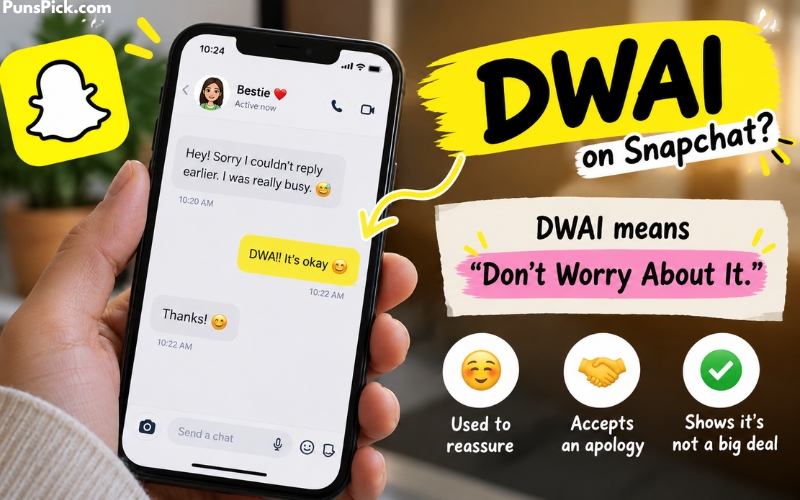
DWAI is commonly described as an abbreviation or initialism formed from the words “Don’t Worry About It.” Each letter represents a word in the original expression. In everyday conversation, people may simply call it texting slang.
The purpose of DWAI is to shorten a complete phrase into a form that is convenient for informal messaging. It is not necessary to use the abbreviation to communicate the same idea, and writing the complete phrase is equally understandable.
For example, someone might write “DWAI, I can fix it” in a message to a friend. In a professional email, the same idea would be clearer as “Please don’t worry about it; I’ll take care of the issue.”
DWAI is generally better suited to casual chats than academic writing, official letters, or formal business communication. Some people may recognize it immediately, while others may be unfamiliar with the abbreviation.
Texting slang varies across age groups, social circles, and languages. When communicating with someone who may not understand the expression, using the complete phrase can prevent confusion.
Can DWAI Have a Different Meaning?
Yes. Although “Don’t Worry About It” is a common interpretation of DWAI in informal texting, the same letters can have a different meaning in specialized settings.
In some legal jurisdictions, DWAI is used to refer to “driving while ability impaired.” This is associated with impaired-driving offenses and is unrelated to the reassuring expression used in everyday Snapchat conversations.
The context helps distinguish these meanings. If the abbreviation appears in a message about an apology, a missed plan, or a minor mistake, “Don’t Worry About It” is a reasonable interpretation. If it appears in a legal document, court report, or discussion about driving laws, it may refer to the legal term instead.
| Context | Meaning of DWAI | Explanation |
| Casual Snapchat conversation | Don’t Worry About It | Reassures someone about a situation. |
| A friend responding to an apology | Don’t Worry About It | Suggests the mistake is not a major issue. |
| Discussion about impaired-driving laws | Driving While Ability Impaired, where that term applies | Refers to a legal concept in some jurisdictions. |
| An unfamiliar message without context | Uncertain | More information may be needed to identify the intended meaning. |
If you encounter DWAI in a legal context, do not assume that it means “Don’t Worry About It.” Legal terminology and definitions vary by jurisdiction, so the relevant local law should be consulted for an accurate explanation.
Related Post: What Does HYB Mean in Text?
Common Mistakes People Make When Understanding DWAI
One common mistake is assuming that DWAI always means the sender is happy or has no concerns. The phrase is usually reassuring, but it cannot reveal every feeling a person may have. Someone might accept an apology while still wanting to discuss the issue later.
Another mistake is treating DWAI as a romantic signal. The abbreviation does not independently show attraction, affection, or interest in a relationship. It is used in ordinary conversations between friends, family members, classmates, and partners.
People sometimes confuse DWAI with DW because both abbreviations are used to reassure someone. DW usually means “Don’t Worry,” whereas DWAI includes “About It.” Their meanings overlap, but the phrases are not exactly the same.
It is also a mistake to assume that every abbreviation has one universal meaning in every setting. Online language varies, and some communities use the same letters differently.
To avoid confusion, follow these simple guidelines:
- Read the messages before and after the abbreviation.
- Consider the subject being discussed.
- Do not assume that a short reply reveals the sender’s complete feelings.
- Distinguish everyday slang from legal or technical terminology.
- Ask the sender for clarification when the meaning remains uncertain.
These steps can help you understand informal messages without overinterpreting them. In most ordinary Snapchat conversations, the common meaning is straightforward, but context remains useful.
Related Post: What Does DC Mean In Test?
FAQs
1. What does DWAI mean on Snapchat?
DWAI usually means “Don’t Worry About It” on Snapchat. People use it to reassure someone after an apology, a small mistake, or an inconvenience. For example, if you apologize for replying late and your friend sends “DWAI,” they are probably saying that the delay is not a problem. The expression is informal and is also used in ordinary text messages and other social media conversations.
2. What does DWAI mean in text messages?
In everyday text messages, DWAI commonly stands for “Don’t Worry About It.” It can be used to accept an apology, reassure another person, or indicate that a small issue does not need further attention. For example, someone might write “DWAI, I found the picture” after a friend apologizes for forgetting to send it. The phrase is casual rather than formal, so it is more suitable for informal communication.
3. Does DWAI mean the same thing as DW?
They have similar meanings, but they are different abbreviations. DW usually means “Don’t Worry,” while DWAI usually means “Don’t Worry About It.” Both can reassure someone, but DWAI often refers more directly to an issue that has already been mentioned. The surrounding message helps determine which expression makes the most sense in a particular conversation.
4. Is DWAI a positive or negative expression?
DWAI is generally used as a reassuring expression, so it often has a positive or neutral meaning. It can tell someone that a mistake is not serious or that an apology is unnecessary. However, it may sound dismissive if someone uses it during an important or emotional conversation without offering further reassurance. The letters themselves do not establish the sender’s emotional state.
5. What should I reply when someone says DWAI?
You can reply with “Thanks,” “Okay, I appreciate it,” or “Thanks for understanding.” If you are chatting with a close friend, a casual response such as “You’re the best 😂” may fit the conversation. When the situation is important and you are unsure whether the other person is genuinely comfortable, you can ask, “Are you sure everything is okay?”
6. Does DWAI mean someone likes me?
No, DWAI does not automatically mean that someone likes you romantically. The abbreviation generally means “Don’t Worry About It,” regardless of whether the sender is a friend, classmate, family member, or romantic partner. A person may use it simply to accept an apology or dismiss a small problem. Consider the wider conversation and the person’s behavior rather than relying on DWAI alone.
7. Can DWAI sound sarcastic?
Yes, although sarcasm is not its basic meaning. A person might use DWAI sarcastically if they are annoyed or want to make a pointed comment. However, a brief message is not proof of sarcasm because some people naturally use short replies. Consider the previous conversation and ask for clarification if the meaning matters.
8. Is DWAI appropriate for professional messages?
DWAI is generally better suited to informal conversations than professional communication. In a workplace email, customer service exchange, or formal message, writing the complete phrase is usually clearer. Instead of writing “DWAI, I’ll fix it,” you could write, “Please don’t worry about it; I’ll take care of the issue.” Full sentences help reduce confusion, particularly when communicating with someone who may not recognize texting slang.
9. What does DWAI mean when a girl sends it?
When a girl sends DWAI, the usual interpretation is “Don’t Worry About It.” She may be reassuring you after an apology, telling you that a minor mistake is not important, or indicating that she is comfortable with a change of plans. The meaning does not automatically become romantic because of the sender’s gender. Look at the whole conversation before drawing conclusions about her intentions.
10. What does DWAI mean when a guy sends it?
When a guy sends DWAI, it generally means the same thing: “Don’t Worry About It.” He might be accepting an apology, dismissing a minor inconvenience, or trying to make a conversation less awkward. A short response does not necessarily indicate anger, disinterest, or romantic feelings. The most reliable interpretation comes from the topic, the surrounding messages, and how he usually communicates.
11. Is DWAI used only on Snapchat?
No. DWAI can also appear in text messages, Instagram DMs, WhatsApp conversations, gaming chats, and other informal online settings. Its common texting meaning remains “Don’t Worry About It.” People use the abbreviation when they want to communicate quickly or reassure someone without typing the full phrase. Context remains important because abbreviations can have different meanings in specialized settings.
12. What is the difference between DWAI and NP?
DWAI usually means “Don’t Worry About It,” while NP means “No Problem.” Both expressions can reassure someone, but they are often used in slightly different ways. DWAI may tell someone not to worry about a mistake or inconvenience, whereas NP frequently appears as a response to thanks or an apology. For example, after you say “Thanks for helping me,” a friend might reply “NP.” After you apologize for forgetting something, they might respond “DWAI.”
13. Can I use DWAI with my best friend?
Yes. DWAI is suitable for casual conversations with a best friend. You can use it when your friend apologizes for a late reply, forgets something minor, or worries about changing plans. For example, “DWAI, we can do it tomorrow” tells your friend that there is no need to feel bad about the change. If the issue is serious, however, a more thoughtful response may be more appropriate.
14. What does DWAI mean without an emoji?
DWAI without an emoji still usually means “Don’t Worry About It.” The absence of an emoji does not automatically make the message rude or cold. Some people prefer plain text, while others frequently add emojis to their messages. Consider the sender’s usual communication style and the rest of the conversation before deciding whether the reply is friendly, neutral, or dismissive.
15. What does DWAI mean in legal terminology?
In some jurisdictions, DWAI refers to “driving while ability impaired,” a term associated with impaired-driving offenses. This legal meaning differs from the everyday Snapchat expression. If you see DWAI in a court document, legal notice, or discussion about driving laws, consider the jurisdiction and the document’s context. The applicable local law is the appropriate source for understanding the legal definition and its consequences.
Conclusion
DWAI on Snapchat usually means “Don’t Worry About It.” People use it to reassure friends, accept apologies, and show that a small mistake or inconvenience is not a serious problem.
The abbreviation also appears in text messages and other social media conversations. Its tone can be friendly, neutral, or occasionally dismissive, depending on the situation and the surrounding messages. It does not automatically indicate romantic interest or reveal everything a person feels.
When someone sends you DWAI, a simple response such as “Thanks” or “Okay, I appreciate it” is often enough. If the conversation involves something serious or the meaning is unclear, ask the person directly rather than guessing.
Remember that abbreviations can have different meanings in different settings. In everyday Snapchat conversations, “Don’t Worry About It” is the common interpretation, but context is the best guide to understanding the message correctly.