
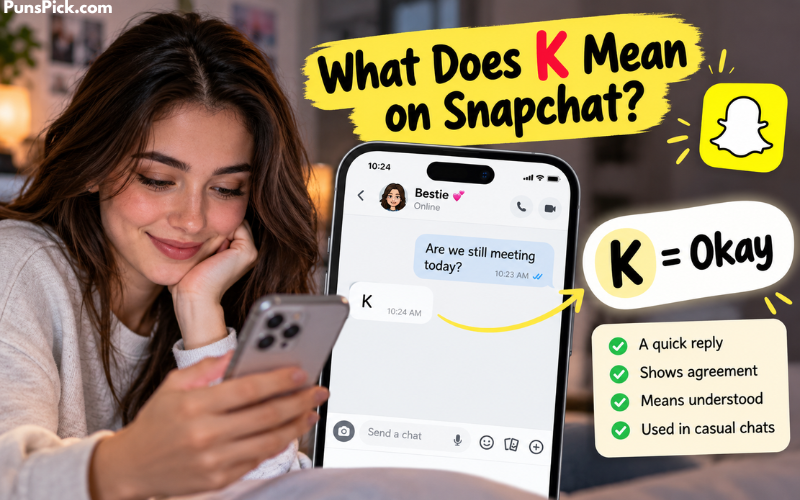
If someone sends you “K” on Snapchat, it usually means “Okay.” It is a short way to acknowledge a message, show agreement, or let someone know that you have understood what they said. However, depending on the conversation, a single “K” can also sound cold, annoyed, or uninterested.
For example, if your friend says, “I will send you the picture later,” and you reply with “K,” you are simply acknowledging the message. But if someone shares their feelings with you and receives only “K” in response, they might feel that you are dismissing them.
The meaning depends on the situation, your relationship with the sender, and the messages that came before it. Understanding these details can help you interpret Snapchat conversations more accurately.
What Does K Mean on Snapchat?
On Snapchat, K stands for “Okay” in most private chats. People use it as a quick response when they do not want to type the full word. It can communicate agreement, acknowledgment, or acceptance without adding much detail.
Snapchat is often used for short conversations, quick replies, and casual communication. Because of this, people sometimes respond with a single letter instead of a complete sentence.
Here are some common meanings of “K” in Snapchat messages:
- Okay: The person agrees with what you said.
- Got it: They understand your message.
- Fine: They accept a suggestion or decision.
- Understood: They have received the information.
- Conversation over: They may not have anything else to add.
- Annoyance or disinterest: In certain situations, they may be responding with little enthusiasm.
For example:
You: “We are meeting at 5 PM, right?”
Friend: “K”
In this situation, the reply probably means that your friend understands and agrees with the plan.
However, if you have been discussing an argument and the other person suddenly responds with “K,” the message may feel dismissive. You should consider the surrounding conversation instead of assuming that every short reply has a negative meaning.
What Does K Mean in Snapchat Chat?
When “K” appears in a Snapchat chat, it is generally a shortened version of “okay.” It may be used after a question, an instruction, a plan, or an ordinary statement. The sender can acknowledge your message without continuing the discussion.
For example, imagine you tell a friend that you cannot join them after school. They reply, “K.” This might simply mean that they understand your decision. There may be no hidden message behind it.
The situation can be different when the conversation is personal. If you apologize for something and receive only “K,” the other person may be upset, may need time to respond, or may simply prefer brief messages. The letter alone does not explain which possibility is correct.
Related Post: What Does TMU Mean on Snapchat? Meaning, Uses, and Examples
The following examples show how the same reply can communicate different things:
| Snapchat message before the reply | Meaning of “K” |
| “I will call you tonight.” | Acknowledgment |
| “Send me the address when you arrive.” | Understanding |
| “Let’s meet outside the school.” | Agreement |
| “Sorry I forgot to reply.” | Possibly accepting the apology |
| “I thought you were my friend.” | Could sound dismissive |
| “I don’t want to talk right now.” | Acceptance or acknowledgment |
Pay attention to the subject of the conversation, the sender’s usual texting style, and whether they continue talking afterward. These details provide more useful clues than the letter by itself.
Is K Rude on Snapchat?
“K” is not automatically rude, but it can come across as cold or dismissive. Some people use it without thinking about its tone, while others choose it deliberately when they want to keep a response short.
The difference often comes from expectations. If you normally exchange detailed messages with a friend, receiving only one letter may feel unusual. You might wonder whether they are angry or whether something has changed between you. On the other hand, a friend who regularly uses short replies may not intend anything negative.
Consider these two examples.
Example 1: A normal conversation
You: “I will bring your notebook tomorrow.”
Friend: “K”
The reply probably means that your friend has received the information and understands the plan.
Example 2: A disagreement
You: “I felt hurt when you ignored me yesterday.”
Friend: “K”
Here, the reply may feel dismissive because you have shared something personal and received no explanation or reassurance.
Even in the second example, you cannot know the sender’s intention from the letter alone. They might be upset, unsure how to respond, or unwilling to discuss the matter at that moment.
If you want to avoid misunderstandings when sending messages yourself, use “Okay,” “Got it,” or “Okay, sounds good” when a warmer response is appropriate. These alternatives provide more context and are less likely to be misunderstood.
What Does It Mean When a Girl Sends You K on Snapchat?

When a girl sends you “K” on Snapchat, it usually means “Okay,” but the exact tone depends on your conversation and your relationship with her. It does not automatically mean that she is angry, losing interest, or trying to end your friendship.
If you ask whether she is available to meet and she responds with “K,” she may simply be acknowledging your message. If you send her a plan or share some information, the reply may be entirely neutral.
However, if you have been discussing a sensitive issue and she responds with only “K,” she might be annoyed, disappointed, or unwilling to continue the discussion. The context matters more than her gender.
Here are a few possible situations:
- She agrees with your plan: She may be using “K” as a quick confirmation.
- She is busy: She might not have enough time to write a longer reply.
- She is upset: A short answer can sometimes reflect frustration.
- She wants to end the conversation: She may not want to discuss the topic further.
- She normally texts briefly: The reply may be part of her usual communication style.
If you are unsure, avoid sending several messages asking why she is angry. You can ask a simple, respectful question if the conversation gives you a genuine reason for concern. For instance, “Hey, is everything okay? I wasn’t sure how to read your last message.”
Give her room to answer in her own time. One letter is not enough evidence to determine how she feels about you.
What Does It Mean When a Guy Sends You K on Snapchat?
When a guy sends you “K” on Snapchat, it generally means “Okay” or “Got it.” It can be a simple acknowledgment, a quick agreement, or a way to finish a conversation. The reply does not automatically indicate that he is angry, bored, or uninterested.
For example, if you tell him that you will message him when you get home and he replies “K,” he may simply be confirming that he understands. If he sends it after an argument, the same response could feel colder because the conversation involves stronger emotions.
Several explanations are possible:
- He wants to acknowledge your message quickly.
- He is busy and does not want to type a longer response.
- He agrees with what you said but has nothing else to add.
- He is annoyed or does not want to continue the discussion.
- He usually communicates with short replies.
You can get a better idea by looking at his communication habits. Does he usually send short answers to everyone, or has his style changed suddenly? Does he continue the conversation later, ask questions, and make plans with you? These patterns provide more context than a single message.
If the reply concerns an important issue, you can ask him directly what he means. A calm question is more reliable than assuming that “K” reveals his feelings or intentions.
What Does K Mean From Your Crush on Snapchat?
If your crush sends you “K,” the most straightforward interpretation is “Okay.” However, you may pay closer attention to the message because you care about how that person feels about you.
A short reply might mean that your crush understands your message but has nothing else to say. It could also mean they are distracted, busy, shy, or not interested in continuing that particular conversation. The letter does not prove any one of these explanations.
For example, suppose you send, “I might see you at the party tomorrow,” and your crush replies, “K.” The message could simply acknowledge what you said. It does not necessarily mean that they are rejecting you or trying to avoid you.
Instead of judging their interest from one response, look at the wider pattern of communication. Do they start conversations, ask about your day, respond thoughtfully at other times, or make an effort to spend time with you? These behaviors offer more meaningful information.
If your crush regularly gives one-word answers and never makes an effort to continue conversations, they may not be interested in chatting as much as you are. Even then, it is better to consider the overall pattern rather than treating one “K” as a definite answer.
Keep your response natural. You do not need to send another message just to get a longer reply. Let the conversation develop at a comfortable pace.
What Is the Difference Between K, OK, Okay, and KK on Snapchat?
“K,” “OK,” “Okay,” and “KK” can all communicate acknowledgment, but they may create slightly different impressions in a Snapchat conversation. The differences are informal rather than strict rules, so people may use them in different ways.
| Reply | Common meaning | How it may sound |
| K | Okay | Very brief; sometimes cold |
| k | Okay | Casual; may feel blunt |
| OK | Agreement or acknowledgment | Neutral and direct |
| Okay | Agreement or understanding | Clear and natural |
| KK | Okay, got it | Often casual and friendly |
| Okay 😊 | Agreement | Usually warmer |
| Sure! | Agreement | Often positive |
| Got it | Understanding | Clear and practical |
A single “K” can seem less friendly than “Okay, thanks!” because it provides no extra words or emotional cues. However, the person sending it may not intend to sound unfriendly.
“KK” is often used as a casual acknowledgment, especially among friends. It can feel more relaxed than a single “K,” although the meaning still depends on the person and the conversation.
If you are responding to an important message, choose a reply that communicates your intention clearly. For example, “Okay, I knowing” is more helpful than “K” when someone is explaining a problem or sharing important information.
The goal is not to follow a strict rule about which abbreviation is correct. It is to choose wording that matches the situation and reduces the chance of confusion.
Examples of K Used in Snapchat Conversations

Looking at short conversations can help you knowing how “K” works in everyday Snapchat chats. The letter usually keeps its basic meaning, but the preceding message changes how the reply may be understood.
Example 1: Confirming a plan
You: “Let’s meet at the mall at 4 PM.”
Friend: “K”
Meaning: Your friend has acknowledged the plan. If they have already agreed to meet, there is probably no reason to interpret the reply negatively.
Example 2: Responding to an update
You: “I just reached home.”
Friend: “K”
Meaning: They have received your update. They may not have anything else to say about it.
Example 3: After an apology
You: “I’m sorry I didn’t reply to your messages yesterday.”
Friend: “K”
Meaning: They may have accepted the apology, but the short response does not confirm whether they are fully okay with what happened.
Example 4: During an argument
You: “I don’t like it when you make jokes about me.”
Friend: “K”
Meaning: The reply might feel dismissive, especially if you expected a more thoughtful response. The sender could also be unsure what to say.
Example 5: Ending a discussion
You: “I have to finish my homework now. Talk later.”
Friend: “K”
Meaning: They acknowledge that the conversation is ending for now.
Example 6: Replying while busy
You: “Can you send me the notes when you get time?”
Friend: “K”
Meaning: They may be agreeing to your request. You can wait to see whether they follow through instead of assuming they are annoyed.
These examples demonstrate why it is useful to separate the literal meaning of a message from the tone you think it carries.
Why Do People Reply With Just K on Snapchat?
People use “K” for several practical and social reasons. The simplest explanation is convenience: it takes less time to type one letter than a complete sentence. In a quick conversation, a brief acknowledgment may be enough to keep the exchange moving.
Another reason is habit. Some people use abbreviations in almost every chat and do not think much about how each reply might sound. They may send “K” to friends, relatives, and classmates without intending to express a particular emotion.
In other situations, the short reply may be deliberate. A person might want to acknowledge your message without starting another discussion. They could be busy, tired, distracted, or unsure how to respond to a difficult topic.
A few common reasons include:
- Speed: The sender wants to reply quickly.
- Convenience: They do not feel a longer response is necessary.
- Agreement: They understand and accept what you said.
- Limited interest in the topic: They have nothing more to contribute.
- Emotional distance: They may be upset or unwilling to continue talking.
- Personal texting habits: They prefer short messages over detailed replies.
It is useful to remember that these are possibilities, not conclusions. The same person may send “K” for different reasons at different times. Their next message, behavior, and usual communication style can help you understand the situation more accurately.
How Should You Reply When Someone Sends K on Snapchat?
Your response should depend on what you were discussing and whether another reply is necessary. You do not always need to answer a single “K.” Sometimes the conversation has already reached a natural stopping point.
If the message concerns a simple plan or update, you can leave it there. If you need confirmation about something important, ask a clear follow-up question rather than guessing what the sender intended.
Here are a few possible responses:
| Situation | Suggested reply |
| They confirm a meeting | “Great, see you then!” |
| They acknowledge an update | No reply may be necessary |
| You need a clear answer | “Just checking, does that time work for you?” |
| They seem upset after a disagreement | “Can we talk about this when you’re ready?” |
| You are unsure about their tone | “Everything okay?” |
| They agree to do something | “Thanks, I appreciate it.” |
If the conversation is emotional, avoid replying with another short message just to make the other person feel the same uncertainty. That can create more confusion without resolving the original issue.
You should also avoid repeatedly asking whether someone is angry when there is no other sign of a problem. Give the person time to respond, and focus on what they actually say and do.
When a short reply becomes part of a repeated pattern that bothers you, it is reasonable to discuss communication preferences. You can explain that you sometimes find one-word answers difficult to interpret without accusing the other person of having a particular intention.
Does K Mean Someone Is Mad at You?
No. A reply of “K” does not automatically mean that someone is mad at you. It usually means “Okay,” and the sender may be using it simply to acknowledge your message.
People often interpret short replies emotionally because written messages do not carry the same vocal tone, facial expressions, or body language as face-to-face conversations. Without those clues, it is easy to imagine a negative meaning that the sender never intended.
For instance, if you tell your friend that you will arrive ten minutes late and they reply “K,” the message may be completely ordinary. If you have just had a disagreement and they respond with “K,” you may reasonably wonder whether they are still upset, but the reply alone cannot confirm it.
Look at the surrounding circumstances before drawing a conclusion. Consider whether the person has mentioned being upset, whether the conversation was already tense, and whether their communication style has changed.
If you have a genuine concern, ask directly and politely. A message such as “I wasn’t sure if my last message upset you. Are we okay?” gives the other person an opportunity to clarify.
Try not to treat punctuation, capitalization, or reply length as proof of someone’s emotions. These details can provide clues, but clear communication is a better way to resolve uncertainty.
Does K Mean Thousand on Snapchat?
The letter “K” can also mean one thousand, but this meaning is different from the use of “K” as a chat reply. It usually represents a number when it appears after a figure, particularly in social media statistics, follower counts, views, and money amounts.
For example, you might see a creator discussing a profile with 10K followers. In that case, 10K means 10,000 followers. The letter is being used as numerical shorthand rather than as a response meaning “Okay.”
Here are some common examples:
| Expression | Meaning |
| 1K followers | 1,000 followers |
| 5K views | 5,000 views |
| 10K subscribers | 10,000 subscribers |
| 25K likes | 25,000 likes |
| $2K | $2,000 |
| 100K views | 100,000 views |
If someone sends you just “K” in a private Snapchat conversation, “Okay” is usually the most likely interpretation. If you see “K” attached to a number, it commonly means thousand.
The surrounding information helps you distinguish the two uses. A reply to a message works differently from a number displayed in a profile statistic or a discussion about money.
Is K a Snapchat-Specific Abbreviation?
No. “K” is not exclusive to Snapchat. It is widely used in text messages and online conversations across platforms such as Instagram, WhatsApp, TikTok, and other messaging services.
Its basic meaning as a short form of “okay” remains similar across these platforms. The main difference is the conversation itself and how the people involved usually communicate.
For example, someone might reply “K” in a WhatsApp group to acknowledge a meeting time. Another person might use it in an Instagram direct message after receiving an update. On Snapchat, it may appear in a private chat following a snap or an ordinary message.
The abbreviation does not have a special meaning simply because it appears on Snapchat. Unless the surrounding context suggests another interpretation, it is reasonable to read it as “Okay.”
The same distinction applies to “K” as a numerical abbreviation. On social media platforms, it can represent one thousand when used with figures, such as a follower count or a view total.
When interpreting any abbreviation, consider where it appears, what was said before it, and whether it forms part of a number. This approach is more reliable than assuming every platform has a separate definition for the same letter.
Common Mistakes People Make When Interpreting K on Snapchat
A frequent mistake is assuming that a single “K” always indicates anger. Although the reply can sound cold, many people use it casually and do not attach any negative emotion to it.
Another mistake is believing that a short reply reveals whether someone likes you. A crush, friend, or partner may send “K” for many reasons. One message is not enough to determine someone’s feelings or level of interest.
People also confuse the two common meanings of “K.” In a conversation, it usually means “Okay.” After a number, it often represents one thousand. The surrounding context determines which interpretation makes sense.
Other common misunderstandings include:
- Assuming the sender wants to end the friendship: A short reply does not prove this.
- Reading too much into capitalization: “K” and “k” usually communicate the same basic meaning.
- Treating every brief response as intentional disrespect: The sender may simply be busy or accustomed to short messages.
- Expecting the abbreviation to have one fixed emotional tone: Tone varies by situation and individual.
- Sending repeated messages for clarification immediately: Sometimes waiting for the next message is the better choice.
The best approach is to read the message in context and avoid making assumptions. If something important remains unclear, a respectful question can help you understand the sender’s intention.
Related Post: What Does GTFO Mean on Snapchat?
FAQs
What does K mean on Snapchat from a girl?
“K” usually means “Okay” when a girl sends it on Snapchat. It may indicate that she understands your message or agrees with what you said. Depending on the conversation, it can also sound distant or annoyed, but the letter alone does not reveal her feelings.
What does K mean on Snapchat from a guy?
When a guy sends “K,” he is generally saying “Okay” or acknowledging your message. He may be replying quickly, agreeing with a plan, or ending the conversation naturally. Consider the context before assuming he is angry or uninterested.
Is K a bad sign on Snapchat?
Not necessarily. “K” is a common informal acknowledgment and can be completely neutral. It may feel dismissive in an emotional conversation, but it is not proof that a friendship or relationship is in trouble.
What does a lowercase k mean in Snapchat chat?
A lowercase “k” usually means “Okay,” just like an uppercase “K.” Some people may perceive the lowercase version as more casual, but capitalization does not reliably reveal the sender’s mood.
What does K mean after an argument?
After an argument, “K” can feel cold because it offers little explanation or reassurance. The sender might be upset, need time to think, or simply not want to continue the discussion. If the issue matters, consider asking to talk when both of you are ready.
What does K mean from your crush?
From a crush, “K” usually means “Okay.” It may be a simple acknowledgment or a sign that the conversation has reached a stopping point. You cannot determine romantic interest from this single reply; consider the broader pattern of communication.
What does K mean when someone replies to your snap?
When someone replies “K” after receiving a snap or message, they are usually acknowledging it. The exact meaning depends on whether your snap contained a question, an update, a plan, or something that required a more detailed response.
What is the difference between K and KK on Snapchat?
Both usually mean “Okay.” A single “K” can sometimes sound blunt, while “KK” often feels more casual or friendly. However, different people use these abbreviations differently, so neither one has a guaranteed emotional meaning.
Does K mean okay or thousand on Snapchat?
Both meanings are possible. When someone sends “K” as a standalone chat reply, it usually means “Okay.” When it appears after a number, such as 5K, it generally means five thousand.
Should I reply when someone sends K?
You do not always need to reply. If the person has acknowledged your message and the conversation is finished, you can leave it there. If you need confirmation or believe an important issue remains unresolved, ask a clear follow-up question.
Does K mean someone is ignoring me?
No. A single “K” does not prove that someone is ignoring you. They may have read your message and acknowledged it without adding anything else. Look at their communication over time rather than judging their intentions from one short reply.
What should I say instead of K on Snapchat?
You can use “Okay,” “Got it,” “Sounds good,” “Sure,” or “Okay, thanks.” These replies provide more context and may sound warmer than a single letter, especially when you are discussing plans or responding to something important.
Conclusion
On Snapchat, “K” usually means “Okay.” People use it to acknowledge messages, agree with plans, or respond quickly without typing a complete sentence. In some conversations, it can sound cold or dismissive, especially when the subject is personal or emotional.
The meaning depends on the context, the sender’s usual communication style, and the messages that came before it. A single “K” does not prove that someone is angry, uninterested, or trying to end a relationship.
If you receive this reply, consider what you were discussing before deciding how to interpret it. When you need clarity, ask a calm and direct question. When you send messages yourself, using a few extra words can help you express your meaning more clearly and avoid unnecessary misunderstandings.